
Choosing a Factory in Turkey: We Almost Got It Wrong
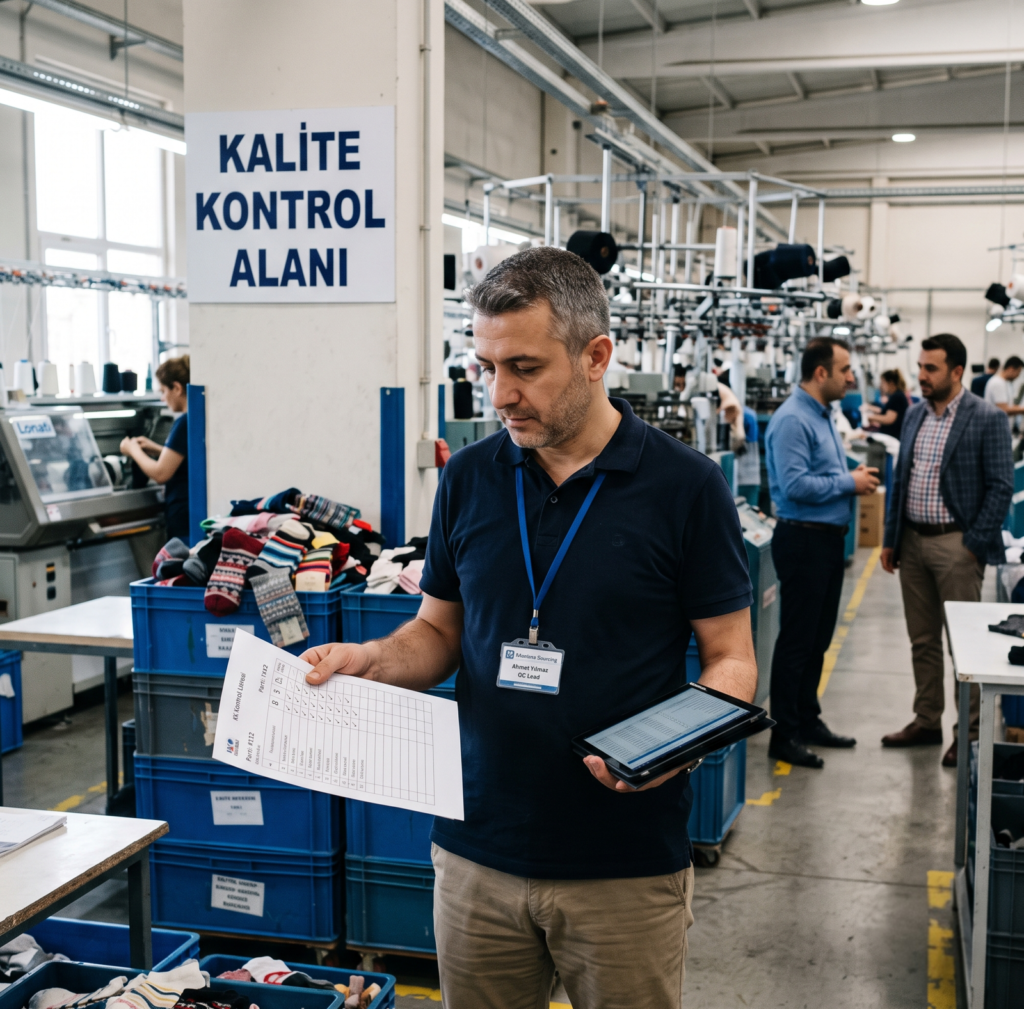
Choosing a factory in Turkey on paper and choosing one after an audit can lead to two completely different decisions.
This is not the kind of post we planned to write. But it is probably the most useful one we have published.
In January 2026, our team visited two Turkish socks factories on the same day — both shortlisted for the same client brief. We published the full field report from those visits a few weeks ago. That post covered what we found. This one covers what we almost missed.
Halfway through that day, our team was leaning toward the wrong factory. Not because we were careless. Because on almost every measurable metric, that factory looked stronger. And it took one moment on the production floor to change our assessment entirely.
Here is the honest account of what happened.
1. Why Factory B Looked Like the Right Choice
By mid-morning, Factory B had made a strong impression. On paper and in the opening conversation, it had several genuine advantages over Factory A.
It ran export sales only — no domestic market. That meant its entire operation was oriented around international quality standards. It worked three shifts, six days a week, which signalled strong commercial demand and a well-utilised production line. Its quality control team offered something Factory A did not: daily production QC reports sent directly to clients. For a European buyer managing an order from a distance, that kind of visibility is genuinely valuable.
Furthermore, the management team was articulate and confident. The export manager spoke excellent English and answered every question directly. The factory owner was present throughout. On technical specification questions — needle ranges, compression sock capability, AQL inspection standards — their answers were precise and credible.
At the halfway point of our visit schedule that day, Factory B was ahead. Not by a dramatic margin, but clearly ahead.
2. The Moment That Changed Everything
We were walking the production floor when we noticed something small. In one section of the line, a batch of finished socks sat in an open bin, unsorted and unlabelled, next to a packaging station.
We asked about it. The answer was reasonable — a brief explanation about a packaging changeover between two client orders. Nothing alarming on its own.
But then we asked a follow-up question: how does the factory track which finished units belong to which client order during a changeover? How does it prevent mixing?
The answer was less precise. There was a process, we were told. It worked in practice. They had never had a mixing issue.
We pressed gently — not aggressively, but specifically. We asked to see the documentation for that process. There was a pause. Then a conversation in Turkish between the export manager and a production supervisor. Then a clarification that the documentation was in development.
In other words, it did not yet exist in a formal, written form.
| Why this mattered For a client ordering compression socks alongside other technical styles, batch segregation during production changeovers is not a minor administrative detail. It is the difference between receiving the right product and receiving a mixed shipment that fails at the client’s warehouse. A verbal process with no documentation is a risk — especially when production runs at three shifts across six days. |
3. What Factory A Had That We Had Almost Overlooked
We visited Factory A later that same day. Going in, our assessment already had Factory B slightly ahead. As a result, we paid closer attention to Factory A than we might have otherwise.
The production floor was quieter than Factory B’s — one shift, not three. The annual capacity was higher at 12 million pairs versus 10 million. However, what struck us was a detail we had noted but not fully weighted in our initial assessment.
At every production stage, the QC documentation was active and visible — not filed away or prepared for our visit, but in use. Each batch carried a physical tag with order details, client code, and inspection status. The packaging station had a clear separation protocol between client orders, with a sign-off sheet attached to each bin.
We had seen this during our first walk of the floor. We had noted it as a positive. But we had not fully understood its significance until the question at Factory B revealed the gap.
Factory A’s system was not sophisticated. It was not digital, not automated, and not impressive-looking. However, it was documented, it was consistent, and it was genuinely in use. That is what matters in practice.
4. What This Changed in Our Recommendation
Our final recommendation remained the same as what we eventually published: Factory A as primary supplier, Factory B as a qualified backup with the option to split purchase orders over time.
However, the reasoning behind that recommendation shifted significantly from what it would have been at mid-morning.
Factory B’s strengths are real. The export-only model, the QC reporting capability, the technical socks experience, the management quality — none of that changed. Those remain genuine advantages. Moreover, the batch segregation gap is not necessarily a permanent disqualifier. It is a process maturity issue that a well-run factory can address. We noted it in our report and recommended that it be resolved before Factory B takes on a primary order.
Factory A won the primary recommendation not because it was more impressive overall, but because it had one thing that ultimately mattered more than any individual feature: a reliable, documented, consistently applied quality process on the floor — not just in the presentation.
5. The Lesson We Take from This
We have conducted dozens of factory visits across Turkey. We follow a consistent framework for every visit — the building, the welcome, the access, the conversation, the floor. Nevertheless, this visit reminded us of something important.
The most significant risk in supplier selection is not the factory that is obviously bad. It is the factory that is genuinely good in most respects, with one gap that only surfaces when you ask the right question at the right moment.
Factory B would have been a plausible recommendation. Most remote evaluation processes — trade platforms, supplier questionnaires, video calls, sample reviews — would not have surfaced the batch segregation gap at all. The samples were excellent. The capability was real. The team was professional.
The gap only appeared because someone was standing on that floor, watching that specific moment, and asked a follow-up question about something that looked routine.
That is what a sourcing agent does. Not just auditing against a checklist, but reading the floor in real time — knowing which questions to ask, and when to press.
The Bottom Line
We almost recommended the wrong factory. Not because we were negligent — we followed our full supplier auditing guide process. Because the gap was subtle enough to look like a minor operational detail until one specific follow-up question turned it into a meaningful risk signal.
The right factory won the recommendation. The client’s first order went to a supplier with a documented, reliable quality process. That is the outcome that matters.
But we are sharing this because it is a useful reminder — for us and for anyone sourcing from Turkey — that the difference between a good supplier and the right supplier is often not visible in the data. It is visible on the floor.
| Evaluating Turkish suppliers for your next order? Mopcons visits factories, conducts supplier audits, and gives clients an honest, unfiltered picture of what they are actually buying into. We ask the follow-up questions — the ones that only make sense when someone is standing in the room. Get in touch to discuss your sourcing brief. |
Frequently Asked Questions
What is batch segregation in manufacturing?
Batch segregation is the process of keeping different production orders physically separate during manufacturing and packaging. It prevents mixing of products intended for different clients, specifications, or delivery destinations. A documented, consistently applied segregation process is a basic quality requirement for any factory producing multiple client orders simultaneously.
How do you assess a factory’s quality process during a visit?
We look for documentation that is actively in use — not filed or presented for the visit, but visible and operational on the floor. We also ask specific follow-up questions about edge cases: what happens during a changeover, how batches are tracked across shifts, and how a quality issue would be escalated. The answers to these questions reveal more than a formal QC presentation.
Can a factory fix a gap identified during an audit?
Yes — and in many cases, identifying and addressing a gap early is exactly what a good audit process should achieve. Factory B’s batch segregation issue was a process maturity gap, not a fundamental capability problem. A factory willing to formalise and document that process becomes a stronger, more reliable supplier as a result.
How often should we audit existing suppliers?
For active suppliers producing regular orders, an annual on-site audit is a reasonable baseline. For higher-volume or higher-risk categories, more frequent visits or production monitoring during active orders provide stronger assurance. The goal is not surveillance — it is maintaining the kind of relationship where problems surface before they become shipment failures.
Need help with sourcing or trade in Turkey?
Talk to a MOPCONS consultant — we handle export, import, sourcing, representation and contracts end to end.
Related Articles
 Business
The Cost of Not Having a Local Rep in Turkey
A buyer paid thousands of euros to a sourcing agent who was not based in Turkey. No factory knew him. Here is…
Read article →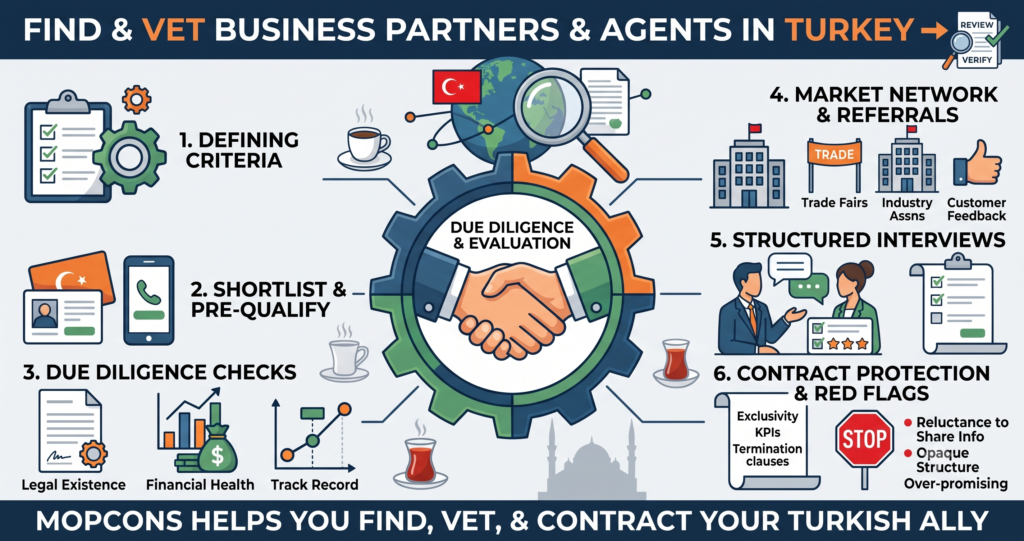 Business
How to Find and Vet a Business Partner in Turkey
A step-by-step method for foreign firms to find, vet and safely contract a reliable business partner or agent in Turkey.
Read article →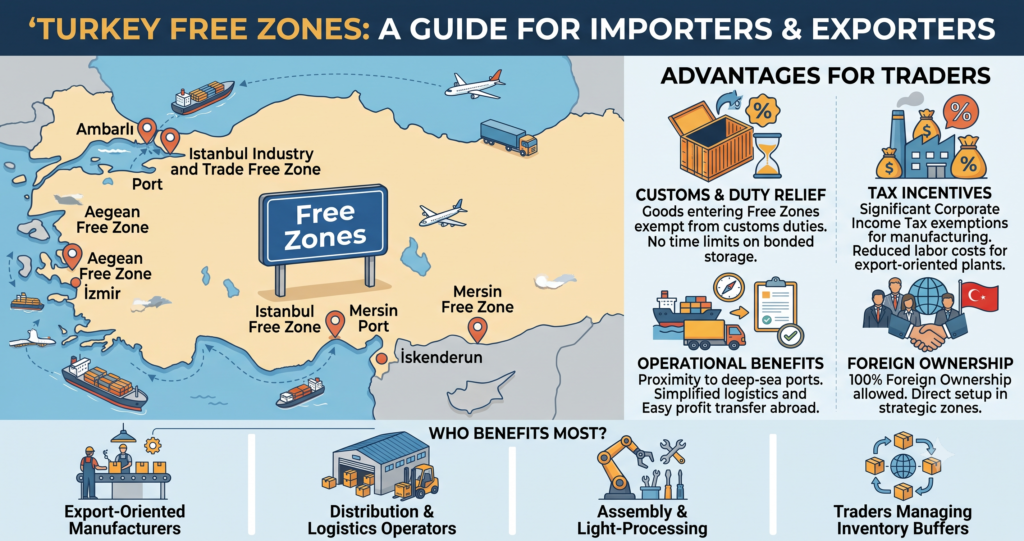 Business
Turkey Free Zones: A Guide for Importers and Exporters
How Turkey's free zones cut customs duties and taxes for importers, exporters and manufacturers, and how to choose the right one.
Read article →