
Sourcing Agent vs In-House Procurement Turkey: Which is Right for Your Business?

Nearshoring production offers European and UK businesses incredible advantages in lead times, quality, and cost. However, executing a successful cross-border supply chain strategy forces leadership to answer a critical operational question. When deciding on a sourcing agent vs in-house procurement Turkey strategy, which model will best protect your brand and optimize your Total Cost of Ownership (TCO)? While a dedicated internal team provides direct control, placing boots on the ground in a foreign manufacturing landscape presents unique challenges.
Here is a definitive comparison to help you determine which approach is right for your business.
1. The Cost Factor: Sourcing Agent vs In-House Procurement Turkey
Building an internal procurement desk means absorbing significant fixed costs. You are paying European-level salaries, benefits, and ongoing training costs for supply chain managers. Furthermore, managing suppliers locally requires frequent travel. The cumulative cost of last-minute flights to Istanbul, hotels, and lost administrative time drastically increases the TCO of every unit you produce.
A local consultancy, on the other hand, operates on a flexible, outcome-driven model. You eliminate the overhead of full-time salaries and international travel expenses. You are essentially renting a fully operational, localized procurement infrastructure only when you need it, turning a massive fixed cost into a manageable variable cost.
2. The “Unannounced Visit” Advantage
If your procurement manager is sitting in London or Berlin, visiting a factory requires planning. Suppliers know exactly when your team is arriving, giving them weeks to clean the factory floor, hide uncertified sub-contractors, and ensure only the best inventory is visible.
Physical proximity is a buyer’s greatest leverage. A local agent can drive to an industrial zone in Bursa or Tekirdağ on a Tuesday morning entirely unannounced. This allows for genuine, unfiltered audits of production lines, worker conditions, and actual daily operating procedures.
3. Cultural & Linguistic Nuance
Language barriers extend far beyond simple communication. If your internal team cannot read official Turkish trade registry documents (MERSIS), deeply analyze local financial stability, or understand the cultural nuances of face-to-face negotiation in Turkish business circles, you are operating at a severe disadvantage.
Local agents operate in their native environment. They know exactly how to verify domestic licenses, navigate local legal frameworks, and read between the lines during supplier negotiations. This cultural fluency ensures contracts are watertight and expectations are clearly understood.
4. The Immediate Network vs. Starting from Zero
A new internal team sourcing abroad starts from zero. They must rely on internet searches, digital catalogs, and B2B platforms—which can easily mask risky operations. Vetting a new supplier network takes months of trial and error.
An established corporate venture focused on supply chain management comes with an immediate, vetted “black book” of reliable manufacturers. Just as importantly, they have a strict “do not call” list of factories known for quality fade or compliance violations. This instantly accelerates your speed to market while drastically mitigating risk.
Conclusion
If you are a massive multinational corporation continuously buying billions of dollars in raw materials, an internal team is necessary. However, for most mid-to-large enterprises seeking agility and localized expertise, evaluating a sourcing agent vs in-house procurement Turkey model clearly points to a local partner as the superior strategic choice.
We act as the dedicated, on-the-ground extension of your business. From initial supplier identification to rigorous quality control and export readiness, we protect your supply chain every step of the way. Contact us today to build a resilient manufacturing partnership.
Need help with sourcing or trade in Turkey?
Talk to a MOPCONS consultant — we handle export, import, sourcing, representation and contracts end to end.
Related Articles
 Business
The Cost of Not Having a Local Rep in Turkey
A buyer paid thousands of euros to a sourcing agent who was not based in Turkey. No factory knew him. Here is…
Read article →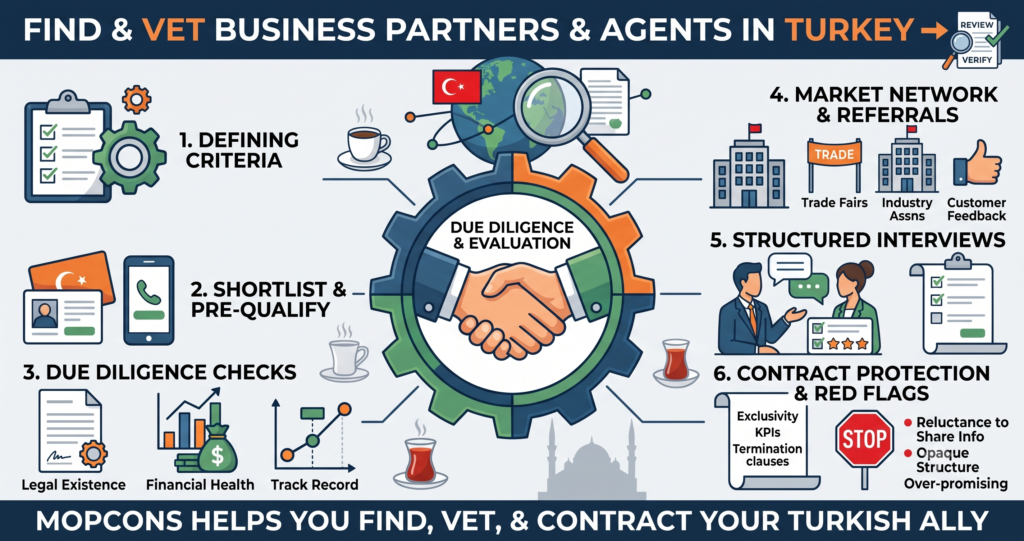 Business
How to Find and Vet a Business Partner in Turkey
A step-by-step method for foreign firms to find, vet and safely contract a reliable business partner or agent in Turkey.
Read article →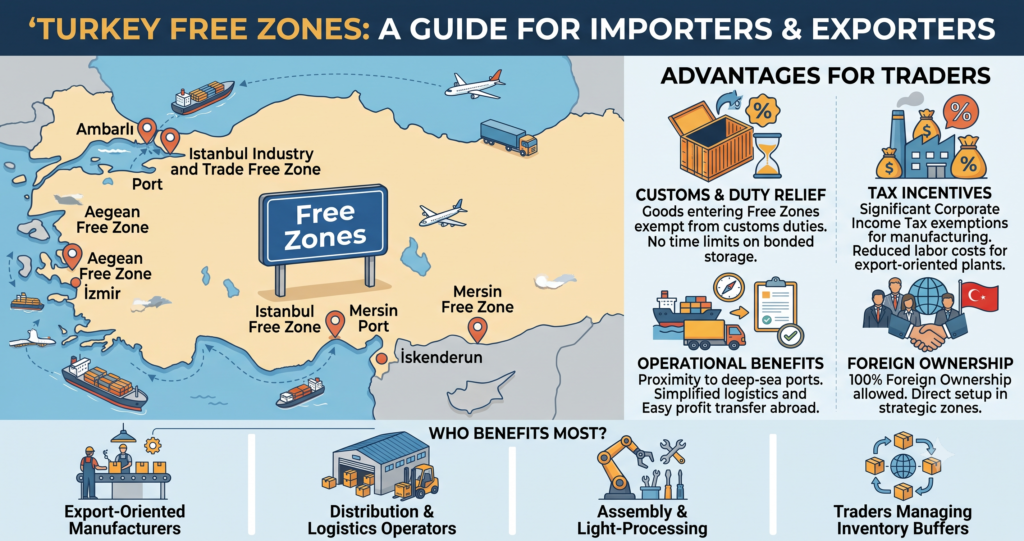 Business
Turkey Free Zones: A Guide for Importers and Exporters
How Turkey's free zones cut customs duties and taxes for importers, exporters and manufacturers, and how to choose the right one.
Read article →