
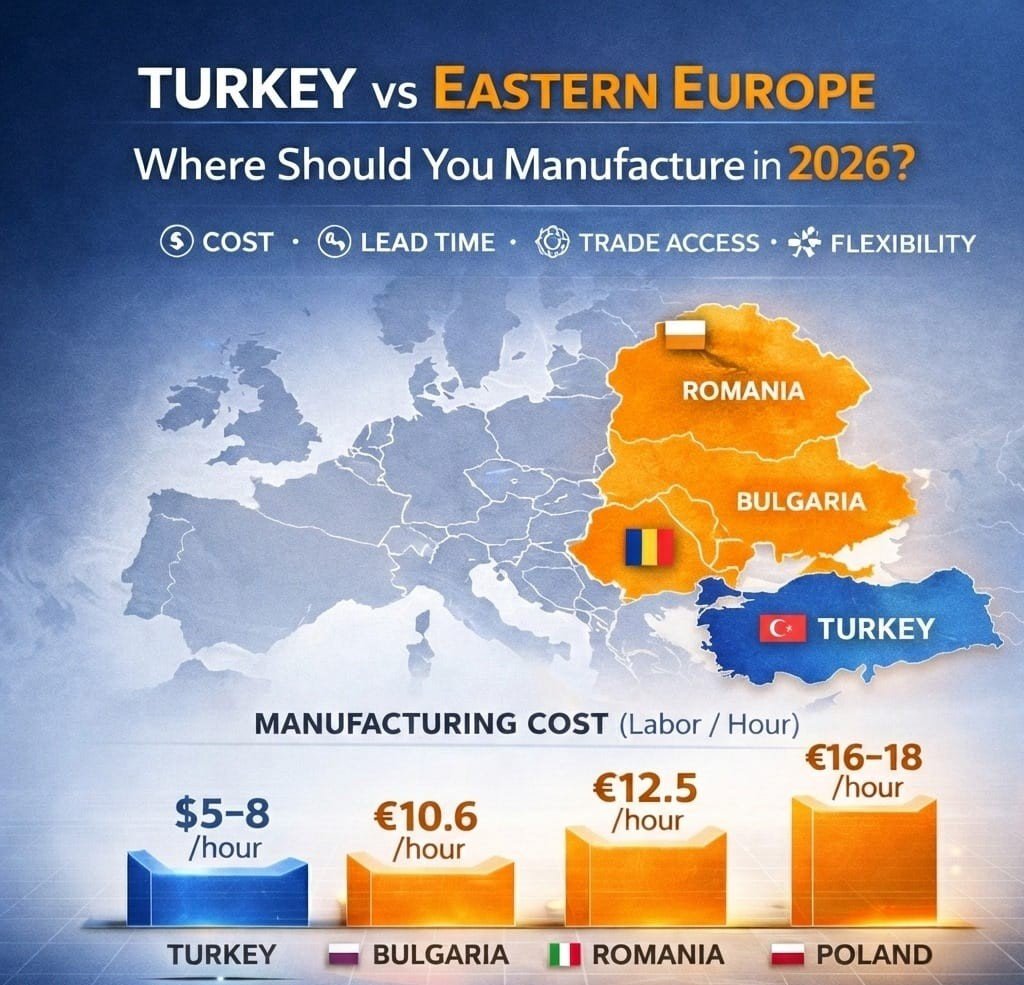
Have you still not decided between Turkey vs Eastern Europe? Should you manufacture in Turkey or Eastern Europe in 2026?
Cost pressure is rising. Energy is volatile. Labor gaps are widening.
Many European buyers are reconsidering their sourcing strategy.
This guide compares manufacturing in Turkey vs Eastern Europe across labor cost, lead time, and trade access.
Labor Cost Comparison in in Turkey vs Eastern Europe (2026 Data)
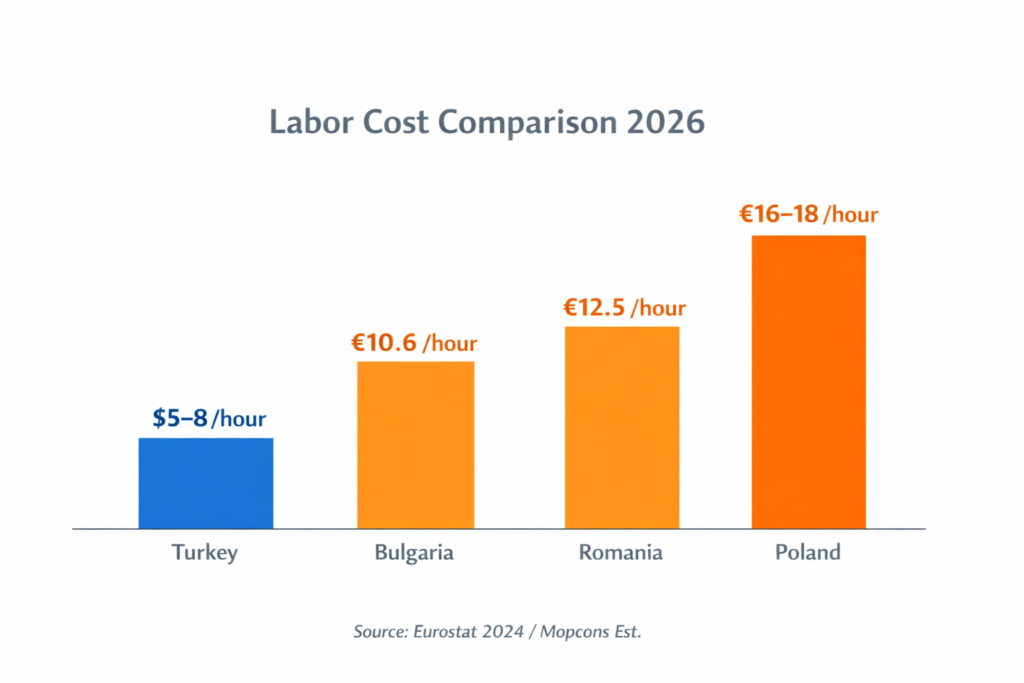
Labor cost remains the biggest driver in supplier selection.
Average hourly manufacturing wages:
- Turkey: $5–8
- Bulgaria: €10–11
- Romania: €12–13
- Poland: €16–18
Turkey offers a clear cost advantage in labor-intensive production such as textile, furniture, and packaging.
However, cost alone does not define competitiveness.
Lead Time & Logistics in Turkey vs Eastern Europe
Lead time often matters more than unit price.
Turkey provides:
- Short sea access to EU ports
- Flexible production volumes
- Fast decision cycles
Eastern Europe offers:
- Road transport inside the EU
- No customs procedures
- Predictable border clearance
For urgent production, Turkey often reacts faster.
For stable, long-term contracts inside the EU, Eastern Europe can offer smoother logistics.
Trade Agreements & Customs
Turkey operates under a Customs Union with the EU.
This means:
- No customs duties on industrial goods
- Simplified trade procedures
- Strong integration with European supply chains
Poland, Romania, and Bulgaria are EU members.
This eliminates border friction entirely.
The real question is not geography.
Thus, it is operational structure.
When checking Manufacturing Costs in Turkey vs Eastern Europe
Turkey becomes the better option when:
- Labor intensity is high
- Supplier flexibility is critical
- MOQ must remain low
- Speed of sampling matters
Turkey is especially competitive in:
- Textile manufacturing
- Furniture production
- Packaging solutions
When Eastern Europe May Be Better
Eastern Europe may be stronger when:
- You require EU-based production labeling
- You want direct access to EU incentives
- You prioritize internal EU distribution
Poland, in particular, has strong industrial infrastructure.
Romania and Bulgaria remain mid-cost EU alternatives.
Final Decision: Strategy Over Cost
The cost gap is visible.
But sourcing is not only about labor. Manufacturing costs in Turkey vs Eastern Europe needs to have a decision.
Besides, energy, supplier maturity, production flexibility, and currency stability all matter.
In recent supplier comparisons we conducted, flexibility and communication speed often outweighed pure wage differences.
The right decision depends on your category, volumes, and growth plans.
Want Help Making the Right Call?
At MOPCONS, we help businesses navigate exactly these sourcing decisions — with on-the-ground expertise in Turkey and established networks across Eastern Europe. Whether you’re evaluating one region or both, we handle supplier vetting, commercial representation, and contract management so you can source with confidence.