
Why Turkish Suppliers Go Quiet — And What It Actually Means

When Turkish suppliers go quiet, the silence almost always means something specific.
Everything was going well. The samples were approved, the deposit was paid, the production timeline was confirmed. Then, somewhere around week three, the replies started slowing down. A message that used to get answered within the hour now takes a day. Then two. Then nothing.
No bad news has been delivered. No problem has been admitted. The supplier just… goes quiet.
For a European buyer managing a production order from a distance, this silence is unsettling. The mind fills in the gaps, usually with the worst-case scenario. The order has been deprioritised, something has gone wrong on the line. Or — in the most anxious version — the money is gone and so is the supplier.
In most cases, none of that is true. But the silence is also not nothing. It is communication — just not the kind a European buyer is trained to recognise.
Here is what’s actually happening when a Turkish supplier goes quiet, and what to do about it.
1. Silence Often Means “Nothing New to Report” — Not “Something Is Wrong”
In many Western business cultures, regular status updates are part of professional service. Even if the update is simply “no change.” Silence is treated as a red flag because the absence of information is itself information.
In Turkish manufacturing culture, the logic often runs the other way. If everything is on track, there is nothing to say. Sending a message just to confirm that things are proceeding as planned can feel, to a Turkish production manager, like a waste of everyone’s time. The update will come when there is something to update — a milestone reached, a sample ready, a shipment booked.
This is not a sign of poor communication. It is a different definition of what communication is for. The problem is that two sides operating under two different definitions can both be acting in good faith and still end up frustrated with each other.
The practical fix is to set the expectation at the start of the relationship, not in the middle of an order. Agree on a simple cadence — for example, a short update every Friday, even if it’s just “on track, no issues” — and frame it as part of the working process, not as a sign of distrust. Most suppliers are happy to do this once it has established as a habit. The friction usually comes from trying to introduce it mid-project, when it can feel like a reaction to a perceived problem.
2. They May Be Solving a Problem Before Telling You About It
This is the one that causes the most anxiety, and it’s worth understanding clearly.
We covered in our previous post on negotiation, Turkish manufacturing culture is different. It tends to favour solving problems quietly over escalating them formally. A raw material shipment has delayed. A machine breaks down. A subcontractor falls behind. In these moments, a good production manager’s instinct is often to absorb the problem internally. They find an alternative supplier, shift the schedule, or pull in extra labour. The buyer is only informed once it’s resolved — or once it’s clear it can’t be fixed without affecting them.
From the supplier’s perspective, this is professionalism. They are protecting you from unnecessary worry over something they expect to fix. European buyers often expect to hear about every deviation, however small. So when a problem stays quiet, it can look like the supplier is hiding it.
In this case, the supplier is often actively working on the problem during that silence. It’s the worst possible time to receive no update, and also the most likely time for one not to come.
The way through this is not to assume the worst, but also not to assume everything is fine. A warm, specific check-in — “Just checking in on the production timeline, is everything still tracking for the date we discussed?” — gives the supplier an easy, face-saving opening to surface a problem if there is one, without it feeling like an accusation.
3. The Channel Might Be Wrong
A surprising number of communication breakdowns are not about culture at all — they’re about which app the message was sent in.
Many Turkish SMEs run a significant amount of business communication through WhatsApp, even for matters that a European buyer would expect to see in email. Your main contact might respond faster on WhatsApp than email. But if your company’s standard practice is email, you keep sending important updates there. You may simply be messaging a channel they check less often, or with less urgency.
This is especially common with smaller, family-run manufacturers, where the person managing your account may be on the factory floor for large parts of the day and only checks email at certain times.
If you’ve noticed a pattern where responses on one channel are fast and another are slow, that’s worth paying attention to. It’s a simple thing to fix, and it removes one entire category of false alarms.
4. Broader Market Conditions Can Slow Everyone Down
It’s also worth acknowledging that responsiveness across Turkish manufacturing has not been uniform over the past year. Several industrial sectors have experienced a slowdown in order volumes and tighter margins, driven by a mix of regional instability and rising input costs. Manufacturing activity has moderated for an extended period, with output and new orders both easing.
In practical terms, this can mean factories running with leaner staff than usual, production managers covering more accounts per person, and less bandwidth for the kind of proactive communication that’s easy to maintain when things are busy and well-resourced.
This isn’t a reason to lower your expectations — but it is useful context. If a supplier who used to respond quickly has become slower across the board, and not just on your account, it may reflect what’s happening at the company level rather than anything specific to your order.
5. How to Respond Without Damaging the Relationship
The instinct when a supplier goes quiet is to escalate — more messages, shorter intervals, a sharper tone. This is usually the wrong move, and here’s why.
A sequence of increasingly urgent messages sent over a short period can read, in Turkish business culture, as a loss of trust or even as disrespectful — particularly if the relationship has been positive up to that point. The supplier may respond to the tone rather than the content, becoming more guarded rather than more forthcoming.
A better sequence looks like this:
- Wait a reasonable interval — for routine updates, a few days is normal, not alarming
- Send one warm, specific check-in rather than a list of questions
- If there’s no response within a few days, try a different channel (move from email to WhatsApp, or vice versa)
- If still no response after that, a phone call is more effective than another message — voice carries warmth that text often loses
- Only escalate formally (referencing contract timelines, requesting written confirmation) if the silence continues well beyond what’s reasonable for the type of update you’re expecting
This sequence respects the relationship while still protecting your timeline. It also leaves the door open for the supplier to come back with good news without anyone having to address an awkward gap in communication directly — which, in this context, matters more than it might seem.
The Bottom Line
Silence from a Turkish supplier is rarely the disaster it feels like from a distance. More often, it’s a mismatch between two different ideas of what communication during production supposed to look like — and a few practical habits, like agreeing on an update cadence upfront and using the right channel, prevent most of the anxiety before it starts.
That said, silence can occasionally signal a real problem, and the skill is in telling the difference — knowing when to give it a few more days, and when something needs a closer look.
This is one of the most common reasons European buyers choose to work with a local partner for production monitoring. Not because they can’t communicate with their suppliers, but because someone on the ground can read the situation in real time — and step in at exactly the right moment, in exactly the right way.
| Managing production from a distance? Mopcons provides on-the-ground production monitoring across Turkey — maintaining the relationship, reading the situation accurately, and keeping your timeline on track without damaging the supplier relationship in the process. If communication gaps are costing you sleep, let’s talk. |
Frequently Asked Questions
How long should I wait before following up with a Turkish supplier?
For routine production updates, two to three days of silence is generally normal and not a cause for concern. If a specific milestone or deadline has passed without confirmation, a check-in is reasonable at that point. The key is to make the first follow-up warm and specific rather than urgent.
Is WhatsApp appropriate for business communication with Turkish suppliers?
Yes — WhatsApp is widely using for business communication in Turkey, including at senior levels, and is often the fastest way to reach a contact. It works well alongside email for formal documentation; many successful working relationships use both channels for different purposes.
What’s the difference between a supplier going quiet and a supplier going dark?
A supplier going quiet typically means reduced frequency of updates while the relationship and order remain intact. A supplier going dark — no response across multiple channels over an extended period, missed payment confirmations, or unreachable contacts — is a different and more serious situation that usually warrants direct escalation and, if needed, local support to investigate.
Should I include communication expectations in my contract?
It can help to outline a basic reporting cadence as part of your production agreement — for example, weekly status updates during active production. This sets a shared expectation from the outset and reduces the chance of misreading normal quiet periods as problems.
Need help with sourcing or trade in Turkey?
Talk to a MOPCONS consultant — we handle export, import, sourcing, representation and contracts end to end.
Related Articles
 Business
The Cost of Not Having a Local Rep in Turkey
A buyer paid thousands of euros to a sourcing agent who was not based in Turkey. No factory knew him. Here is…
Read article →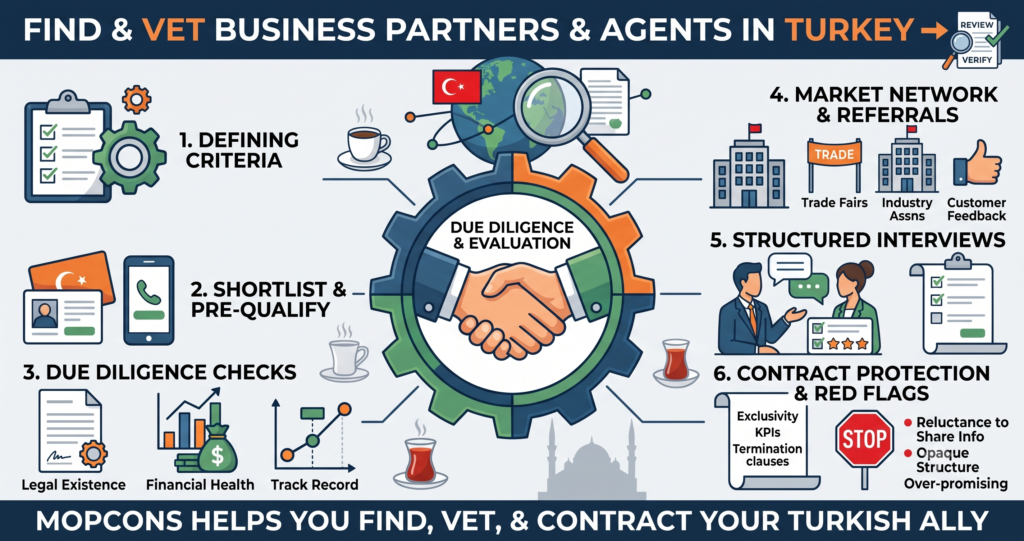 Business
How to Find and Vet a Business Partner in Turkey
A step-by-step method for foreign firms to find, vet and safely contract a reliable business partner or agent in Turkey.
Read article →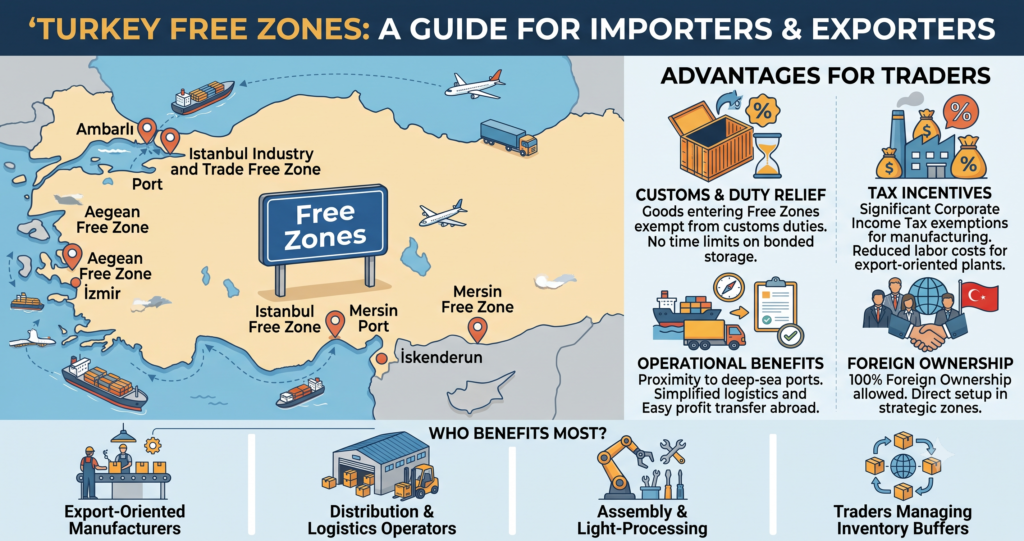 Business
Turkey Free Zones: A Guide for Importers and Exporters
How Turkey's free zones cut customs duties and taxes for importers, exporters and manufacturers, and how to choose the right one.
Read article →