
What to Do When Your Turkish Supplier Is Late
A Typical Scenario in International Sourcing
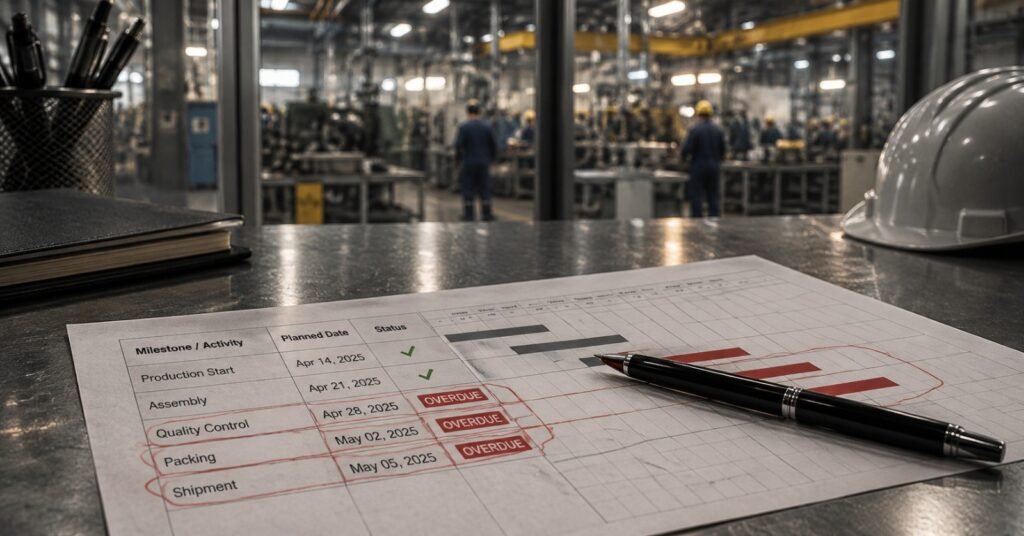
The following scenario illustrates a common type of production delay that international buyers may encounter when sourcing from Turkey.
European buyer. Order placed ten weeks ago. Fifty percent deposit paid. Delivery agreed for last Friday.
By Monday, nothing has shipped. The supplier’s last message: “Minor issue in production. Ready by end of week.” The same message as the week before.
Four more emails are sent. All politely answered. All vague. No new confirmed date. No explanation of what the “minor issue” actually is.
By the time the buyer contacts Mopcons, nine days have passed. A factory visit the following morning shows that production is still significantly behind schedule, with substantial work remaining. There has been a materials shortage for two weeks — one the supplier has been managing around, hoping to resolve quietly before the buyer found out.
The goods ship twelve days after the original date. Without the visit, the buyer would have continued receiving reassurances for another two to three weeks before anyone had a clear picture of what was actually happening.
A late delivery from a Turkish supplier is one of the most common — and most poorly handled — situations in international sourcing. The instinct is to send escalating emails and demand updates. That often fails to reveal the real production situation. The supplier is under pressure and will continue to give optimistic answers because that is the path of least resistance. Meanwhile, the actual situation on the production floor remains invisible.
What you need is a structured response — from the first sign of delay to the moment your goods are on the truck.
Step 1: Stop Relying on Email — Change What You Are Asking
When a supplier tells you there is a “minor delay,” the worst response is to send another message asking “when will you be ready?” You will get another optimistic answer.
Change the type of information you request. Instead of open-ended questions, ask for specific numbers:
- What percentage of production is complete today?
- What specifically caused the delay, and what has been done to address it?
- What is the revised shipment date — not an estimate, but a written commitment?
- Are all materials currently on-site and available?
If the supplier cannot answer these questions in writing, that is information. Vague answers are not reassurance. They are a signal that the supplier either does not know, or does not want you to know.
Step 2: Review Your Purchase Order Before You Escalate
Before sending another message, re-read your purchase order. If you are unsure how the order was set up in the first place, our supplier vetting checklist covers the commercial terms to check. Specifically:
- Is the delivery date written as a binding commitment, or described as an estimate? The language matters.
- Does your purchase order include a contractual penalty clause for late delivery? Check when the penalty becomes applicable, whether the contract specifies any notification or claim procedure, and whether there are limits or conditions attached to it. Do not assume that a separate written notice is always required; this depends on the contract and applicable law.
- What are the agreed Incoterms? The chosen rule determines where delivery takes place, when the risk of loss or damage transfers from seller to buyer, and how transport costs and responsibilities are allocated. Under EXW, risk generally transfers when goods are made available to the buyer at the named place. Under FCA, it transfers when goods are handed over to the buyer’s nominated carrier at the agreed delivery point. Under CIF, risk transfers when goods are loaded on board the vessel at the port of shipment, even though the seller pays for freight and insurance to the destination port. Under DAP, risk transfers when goods are placed at the buyer’s disposal at the named destination, ready for unloading. Incoterms do not, by themselves, determine whether a supplier is liable for a production delay or breach of the agreed delivery date.
- How much of the total order value have you already paid? Outstanding payments may affect your commercial negotiating position, but do not withhold a payment that is contractually due without first reviewing your rights and obligations under the agreement.
If your purchase order is vague on delivery terms or penalty provisions, file that for the next order. It is not something you can fix mid-crisis, but it is worth understanding before you decide how hard to push.
Step 3: Escalate Within the Supplier
If your usual contact — an account manager or sales representative — cannot give you concrete answers, go higher. Request a call or email directly with the production manager or the factory owner.
Escalation signals seriousness. Senior-level escalation can help accelerate decisions. A factory owner who understands that the buyer is engaged at a senior level is more likely to respond substantively than to a junior sales contact managing the communication.
A video call is useful here — not because you can verify production over video, but because it replaces optimistic WhatsApp messages with a real conversation. Ask to be shown the production floor. The supplier’s response to that request will tell you a great deal.
Step 4: Get Someone on the Ground
The core problem in a late delivery situation is not the delay itself — it is that you have no way to verify what is actually happening. Every decision you make is based on what your supplier chooses to tell you. That is a structural disadvantage that email cannot fix.
This is the step most buyers skip — and usually the most effective.
A local representative in Turkey can visit the factory within 24 to 48 hours and provide an independent, documented status report: what percentage of production is complete, whether materials are available, whether the supplier’s revised delivery date is realistic, and whether the explanation you have been given matches what is visible on the production floor.
This does two things simultaneously. It gives you accurate information to make real decisions. And it immediately changes the dynamic with the supplier — who now knows that the buyer has eyes on the ground and is not managing this from a distance by email alone.
Step 5: Assess Your Options Based on What You Find
Once you have a documented picture of the observed production status — which requires step 4 — you can make a real decision. The right response depends on the severity of the delay and the actual state of production.
These time ranges are practical guidelines, not fixed legal thresholds. The actual severity of a delay depends on the original production lead time, order value, contractual commitments, and the impact on the buyer’s business.
Minor delay — up to 2 weeks, production clearly on track. Confirm the revised date in writing. Continue to monitor production through to completion. No further action unless the new date also slips.
Moderate delay — 2 to 4 weeks, production behind but progressing. Request a formal revised schedule with milestone dates in writing. If a partial shipment is possible — some SKUs or quantities already complete — assess whether arranging it now would meet your most critical commitments. Activate production monitoring for the remainder of the order so you are not in this position again in two weeks.
Serious delay — 4 or more weeks, or production significantly behind. Formally document the delay and review your contractual options. If you may need to claim a penalty, seek compensation, or terminate the contract, the applicable requirements will depend on the contract terms and Turkish law. Under the Turkish Code of Obligations (Law No. 6098), the rules on default, additional time for performance, and termination are particularly relevant (Articles 117 and 123–125). A formal written notice is often a prudent step, but whether it is legally required depends on the circumstances and the agreed terms. Seek legal advice before taking formal action. Begin parallel sourcing for critical items as a contingency. Contact Mopcons to arrange an independent assessment of the situation on the ground.
The right question to ask
The question is not “how long is the delay?” It is “what is actually happening on the production floor?” These are different questions and they require different answers — one of which requires a factory visit, not another email.
Step 6: Document Everything
Whatever stage you are at, make sure all communications are in writing. If you have had phone calls or WhatsApp conversations, follow them up with a brief email confirming what was discussed.
Under Turkish law, the consequences of a supplier’s delay depend on the contract terms and the applicable provisions of the Turkish Code of Obligations (Law No. 6098). Articles 117 and 123–125 address default and the creditor’s remedies, while Articles 179–182 regulate contractual penalty clauses. The need for a formal notice or an additional period for performance depends on the circumstances. Keeping a clear written record of agreed dates, missed deadlines, revised commitments, and communications is essential to protecting your commercial position.
A dated email stating “You confirmed on [date] that goods would be ready by [date]. They are not. Please provide a revised confirmed date in writing within 48 hours” creates a useful written record of the delay and the supplier’s response. Where a formal legal notice is required, use the appropriate procedure under the contract and applicable law.
If the situation eventually reaches a formal dispute, the documentation trail is what you will need. Build it from the moment you realise the delivery date has been missed, not after the fact.
Step 7: Protect the Next Order
Once this order is resolved, review what made the delay possible — and what you will do differently next time.
- Production monitoring from kickoff: milestone visits during production mean you know the real status before a delivery date is missed, not after.
- Purchase order language: delivery dates should be written as binding commitments, not estimates. This is a one-line change to your PO template that significantly changes your position.
- Payment structure: milestone-based payments tied to production stages rather than calendar dates give you leverage throughout the order, not just at the start.
- Local representation: a contact on the ground in Turkey means you are never entirely dependent on what a supplier chooses to report. You have the option to verify.
A late delivery handled well — with accurate information, a clear response, and direct supplier communication — should produce a better next order. One handled only by email tends to produce the same situation again.
How Mopcons Can Help When a Delivery Is Late
Mopcons is based in Istanbul. We work with European and UK companies at every stage of sourcing from Turkey — including situations where a buyer contacts us mid-crisis, after days or weeks of trying to manage a late delivery by email.
If your Turkish supplier is late and you do not know what is actually happening on the production floor, we can step in. A factory visit can typically be arranged within 24 to 48 hours of your enquiry.
What we can do in a late delivery situation:
- Factory visit and independent production status assessment
- Written report with photographic documentation of current production state
- Independent assessment of the supplier’s revised delivery schedule, based on observed production progress, material availability, and remaining work
- Direct supplier communication and escalation on the buyer’s behalf
- Coordination of partial shipments where goods are available in stages
- Ongoing production monitoring until the order ships
Your supplier is in Turkey. The gap between what they report and what is happening shouldn’t be a problem you manage from Europe. Mopcons can visit the factory, document the situation, and give you an accurate picture of where your order stands — typically within 48 hours of your first contact. Whether you need a single factory visit to assess the situation, or ongoing monitoring until the order ships, we can support your team on the ground in Turkey. Contact us at info@mopcons.com or see our sourcing agent service.
Once the situation is stabilised and production is complete, a pre-shipment inspection is the natural next step before goods leave the factory.
Frequently Asked Questions
Can I cancel the order if my Turkish supplier misses the delivery date?
That depends on your contract and the circumstances of the delay. If the supplier has failed to meet an agreed delivery obligation, you may have legal remedies under the Turkish Code of Obligations (Law No. 6098). Depending on the circumstances, these may include requesting performance, claiming compensation for delay, or withdrawing from the contract. In certain situations, you may need to grant the supplier an additional period to perform before exercising your right to withdraw. However, an additional period is not required in every case. Review your purchase order, the agreed delivery terms, and any applicable notice requirements before taking action. If cancellation is being considered, seek legal advice before proceeding. In most cases, buyers find that expediting the existing order and strengthening the next one is more practical than cancellation.
Can I claim compensation or a penalty for a late delivery?
You may be entitled to claim compensation for losses caused by the supplier’s delay, depending on the contract and the applicable law. If your purchase order includes a contractual penalty clause, its enforceability and application will depend on the wording of the clause, the nature of the breach, and the relevant legal requirements. Under Turkish law, contractual penalties are addressed in Articles 179–182 of the Turkish Code of Obligations (Law No. 6098). Keep all relevant documentation, including the purchase order, agreed delivery dates, email correspondence, payment records, and evidence of the delay. If you intend to claim a penalty or compensation, obtain legal advice on the appropriate procedure.
What if my supplier stops responding entirely?
A supplier becoming unresponsive is a warning sign, particularly when a delivery date has already been missed. If calls and emails go unanswered for more than 48 hours, escalate immediately — try other contacts at the company and consider arranging an on-site visit through a local representative, subject to the factory’s access and visitor policies. Physical presence cuts through communication avoidance in a way that emails cannot. If the supplier is genuinely uncontactable and the deposit is at risk, document everything and seek legal advice.
How quickly can Mopcons visit the factory after I contact you?
For factories in and around Istanbul, we can typically arrange a visit within 24 hours of your enquiry. For factories in other Turkish cities — Bursa, Izmir, Ankara, Kocaeli and other major manufacturing centres — 24 to 48 hours is the usual timeframe. For more remote locations, we will confirm timing when you contact us. Contact us at info@mopcons.com with your situation and factory location and we will confirm what we can do.
What if the goods are only partially complete — can I arrange a partial shipment?
Yes, in many cases. If part of the order is complete and ready, it may be possible to ship the available goods separately and follow with the remainder when production is finished. Whether this makes commercial sense depends on the agreed shipping terms, carrier availability, additional freight and handling costs, and how urgently you need the completed portion. Check whether partial shipments are permitted under your purchase order and any relevant payment or shipping documentation requirements. If you are in this situation, Mopcons can assess what is physically ready, confirm packaging and documentation status, and help coordinate the logistics of a split shipment.
Sources
- Turkish Code of Obligations (Law No. 6098 / TBK) — Articles 112, 117, 118, 123–125 and 179–182, covering non-performance, default, remedies, and contractual penalty clauses. mevzuat.gov.tr
- ICC Incoterms® 2020 — rules governing delivery obligations, risk transfer, and allocation of costs under EXW, FCA, CIF, DAP and other trade terms. iccwbo.org/business-solutions/incoterms-rules/
- Mopcons — production monitoring, supplier vetting checklist, pre-shipment inspection, sourcing agent service.
Need help with sourcing or trade in Turkey?
Talk to a MOPCONS consultant — we handle export, import, sourcing, representation and contracts end to end.
Related Articles
 Sourcing & Supply Chain
Production Monitoring in Turkey: Why It Matters
A Typical Scenario Week four of an eight-week production order. A European buyer emails their Turkish supplier for a progress update. The…
Read article → Sourcing & Supply Chain
Sourcing from Turkey: A Complete Guide for European Buyers
Why should I buy from Turkey? Turkey is located in the middle of the world due to its location. Turkey is the…
Read article → Sourcing & Supply Chain
How to Vet a Turkish Supplier: A Practical Checklist
Most Turkish manufacturers are genuine, but capability and reliability vary enormously — and some traders present themselves as factories. This is the…
Read article →