
Turkey Produces 60% of the World’s Hazelnuts. Here’s Why 2025 Changed Everything for Buyers.
Last updated: September 2026 — updated with verified market details.
Sourcing hazelnuts from Turkey used to be the most predictable decision in food procurement. Then 2025 rewrote the rules.
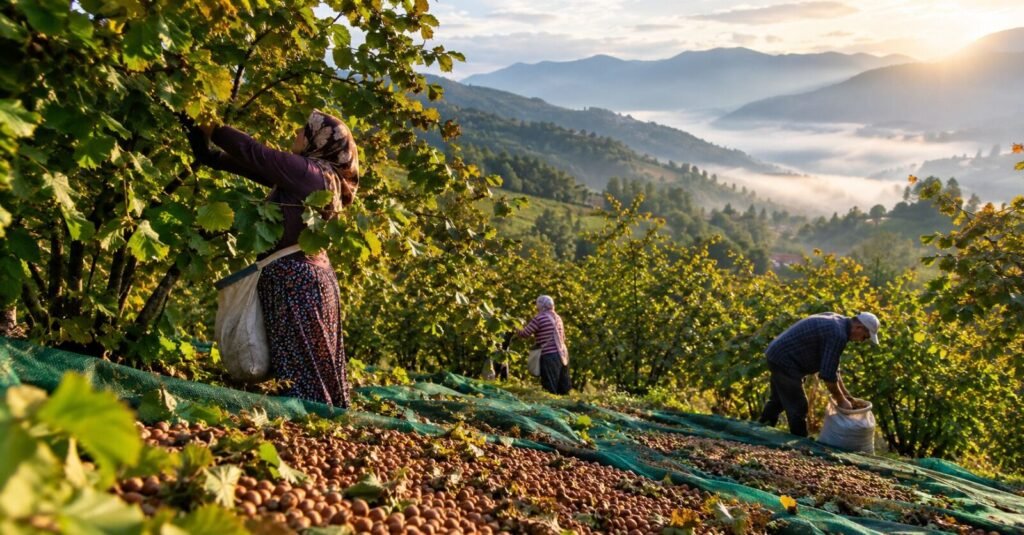
Every jar of Nutella contains Turkish hazelnuts. So does every Ferrero Rocher, every Kinder Bueno, and most of the world’s hazelnut-based confectionery. Turkey does not just lead the global hazelnut market — it controls it, producing approximately 60% of the world’s entire supply from the orchards of its Black Sea coast.
For decades, that dominance made Turkey the most reliable hazelnut origin on earth. Volume was consistent. Quality was established. The supply chain, while complex, was well understood.
Then 2025 happened.
A combination of adverse weather and a devastating pest invasion drove Turkey’s hazelnut harvest to its lowest levels in years. Prices surged to historic highs. And in one of the most dramatic supply chain stories of the year, Ferrero — the world’s single largest hazelnut buyer — halted its purchases from Turkey entirely, triggering a confrontation that reached Turkey’s Competition Authority and reshaped global hazelnut trade.
For any buyer sourcing hazelnuts, or considering it, this is the most important market update of the past decade. Here is what happened, what it means, and how to navigate it.
1. The Scale of Turkey’s Hazelnut Dominance
Before understanding 2025, it helps to understand just how extreme Turkey’s position in the hazelnut market actually is.
Turkey produces approximately 708,000 tonnes of hazelnuts in a normal year, according to International Nut and Dried Fruit Council statistics — around 61% of global production. The next largest producer, Italy, produces a fraction of that. Azerbaijan, Chile, and the United States follow at a significant distance.
Turkey is also the world’s largest hazelnut exporter, accounting for 63% of global export volume. Germany and Italy are the largest importers — and much of the Italian import volume, as with Turkish olive oil, goes to Italian processors who add value and re-export.
The global hazelnut market was valued at $4.2 billion in 2024 and is forecast to reach $6.4 billion by 2035. At the centre of that market, now and for the foreseeable future, sits Turkey.
How dominant is Turkey? Turkey’s hazelnut consumption alone — 706,000 tonnes — is six times larger than Italy’s, the second largest consuming country. Turkey does not just produce hazelnuts for the world. It produces hazelnuts for itself too, at a scale no other country approaches.
2. What Happened in 2025: Pest Invasion, Frost, and a Quality Crisis
The 2025 hazelnut season was disrupted by two compounding threats — and understanding which played the bigger role matters for buyers assessing how durable the problem is.
The primary cause: brown marmorated stink bug invasion
The single biggest factor behind Ferrero’s purchasing halt was not the weather. It was the brown marmorated stink bug (BMSB) — an invasive pest that has spread aggressively across all major hazelnut-growing provinces in Turkey in recent years. The bug damages hazelnuts during development, creating defects that reduce quality to levels unacceptable for premium confectionery use.
In 2025, BMSB infestations were reported across the key producing provinces of Ordu, Giresun, Trabzon, and Rize. The result was not just reduced volume. It was a significant drop in overall harvest quality. That quality collapse, more than the yield reduction itself, was the trigger for Ferrero’s decision to pause purchases. A buyer of Ferrero’s scale and quality standards cannot incorporate heavily damaged raw material into Nutella or Ferrero Rocher, regardless of the price.
A contributing factor: late-season frosts
April 2025 frosts across the Black Sea region also damaged hazelnut orchards — hitting flowers at a vulnerable stage and reducing potential yield. However, industry experts and verified reporting confirm that the frost damage was a contributing factor rather than the primary cause of the crisis. The BMSB infestation was the more significant driver of both the quality problems and the market disruption that followed.
Together, the two threats pushed Turkey’s estimated production down from a normal range of 600,000 to 700,000 tonnes to somewhere between 300,000 and 441,000 tonnes — a reduction of 35 to 55 percent from a typical year.
Why quality matters more than quantity. For buyers supplying premium food manufacturers, hazelnut quality is a harder constraint than volume. A reduced crop at acceptable quality can still be sourced — at a higher price. A crop with widespread pest damage creates a qualification problem that price cannot solve. This is why the BMSB invasion triggered a purchasing halt, not merely a price negotiation.
3. The Ferrero Crisis: A Purchasing Halt and a Regulatory Intervention
In late 2025, Ferrero — the maker of Nutella, Ferrero Rocher, and Kinder Bueno, and the world’s single largest hazelnut buyer — temporarily halted its hazelnut purchases from Turkey.
The decision reflected both the quality concerns described above and Ferrero’s position on pricing. Turkish exporters, facing a dramatically reduced and lower-quality crop, held firm on pricing that Ferrero considered above acceptable levels. Ferrero’s General Manager of Hazelnut Supply stated publicly that the company was “in no hurry to buy” — a negotiating stance supported by the company’s diversified sourcing model, which includes suppliers in Chile and the United States.
Turkey’s Competition Authority steps in
Turkey’s response was swift and formal. The Competition Authority intervened directly, stating that Ferrero’s fulfilment of its purchase commitments was a legal obligation — not a commercial option. Its chairman defended Turkish farmers publicly, calling international pressure tactics unacceptable and describing the portrayal of Turkey’s hazelnut market as speculative or unstable as an injustice to producers.
The intervention went beyond statements. In November 2025, the Competition Authority revised Ferrero’s hazelnut purchase commitments — reducing the company’s mandatory purchase quota to 30,000 tonnes by the end of 2025. The revision acknowledged both the market disruption and the need to protect Turkish farmers from being left entirely without a buyer for their damaged crop.
The standoff made international headlines across Italy, Turkey, and global food industry media. Italian newspapers reported on potential impacts on Nutella supplies. Above all, the episode revealed something structurally important: even the world’s most powerful hazelnut buyer — with ownership of a major Turkish processor, a public Ferrero hazelnut sustainability programme, and over 3,000 people working in its hazelnut supply chain — could not simply exit the Turkish market without regulatory consequences.
What the Ferrero standoff revealed. Turkey’s hazelnut market is not just a commercial relationship between buyers and sellers. It is a politically and legally protected agricultural sector. Buyers who treat it as a pure commodity market — entering and exiting on price alone — will encounter regulatory friction that purely transactional sourcing strategies do not anticipate.
4. The Chile Factor: A New Supply Chain Reality
One of the most significant longer-term developments in the global hazelnut market is the rise of Chile as a competitor to Turkey. Ferrero has invested heavily in expanding hazelnut production in Chile and the United States over the past two years — precisely to reduce its dependence on Turkey during supply shocks like 2025.
Chile’s hazelnut sector is growing aggressively, and industry insiders note ambitions to reach 200,000 tonnes of annual production within five to ten years. For Turkey, this represents a genuine competitive threat for the first time in decades. For buyers, it represents an emerging alternative source — though one that is still years away from matching Turkey’s scale, quality consistency, and processing infrastructure.
The practical implication for sourcing decisions today: Chile is worth monitoring and incorporating into a diversified sourcing strategy, but it is not yet a viable primary source for most buyers. Turkey remains the market. However, the market is changing, and supply chain diversification is no longer optional. After 2025, it is a strategic necessity.
5. What This Means for Buyers Sourcing Hazelnuts from Turkey
The events of 2025 reshaped the hazelnut sourcing landscape in ways that will last several years. Here is the practical framework for buyers evaluating their options.
Quality verification is now non-negotiable
The BMSB invasion has pushed quality risk to the top of every hazelnut buyer’s agenda. Defect rates and damage levels can vary significantly between batches, between regions, and between processors — depending on how aggressively they screened and sorted their intake. Independent laboratory testing and pre-shipment inspection are therefore not optional safeguards. They are baseline requirements for any serious buyer.
Price volatility is the new normal
Turkish hazelnut prices have always been subject to seasonal variation. What 2025 confirmed is that this volatility can be extreme and rapid — driven by weather, pest outbreaks, or the negotiating dynamics between major buyers and the Turkish state. As the USDA hazelnut market report documents, shelled hazelnut prices had already climbed sharply through 2024; the 2025 shock then pushed them past $8,300 per tonne at peak.
Buyers who rely on spot purchasing are the most exposed. Forward contracts and longer-term supply agreements with trusted Turkish processors provide significantly more stability, though they require volume commitment before the season’s outcome is known. Either way, the total cost of sourcing — including rejected lots, re-testing, and replacement stock — is the number that matters, not the headline price per tonne.
Processor relationships matter more than ever
The hazelnut supply chain runs from thousands of small family farms, through local traders, to a relatively small number of large processors. The quality, reliability, and pricing you access depends enormously on which layer you engage — and who you know within it. Working with a local sourcing agent in Turkey who maintains direct relationships with established Black Sea processors gives buyers market access and intelligence that broker-dependent purchasing simply cannot match.
| Factor | Normal year | 2025 supply shock |
|---|---|---|
| Turkish production | 600,000–700,000 tonnes | 300,000–441,000 tonnes (est.) |
| Primary risk | Price seasonality | Quality + volume (pest damage) |
| Global supply share | ~60% | ~50–55% (reduced) |
| Price level | Moderate, seasonal variation | Historic highs — $8,300+/tonne |
| Ferrero status | Active buyer | Quota reduced to 30,000 tonnes (Nov 2025) |
| Alternative sources | Limited | Chile and USA growing — not yet at scale |
6. How to Source Hazelnuts from Turkey: A Practical Guide
Despite 2025’s disruption, Turkey remains the essential hazelnut origin. No alternative market can replace its scale, variety, or processing infrastructure within the next five to ten years. So the question for buyers is not whether to source from Turkey — it is how to do it well.
- Define your quality specification precisely before approaching suppliers — acceptable defect rates, minimum kernel size, maximum moisture, and aflatoxin limits.
- Target established processors in Ordu, Giresun, and Trabzon with demonstrated BMSB screening and sorting capability. This is now a mandatory evaluation criterion.
- Request third-party laboratory testing of every shipment. Aflatoxin and physical defects are both market access issues for EU imports.
- Structure contracts with pre-shipment inspection rights and quality-linked price adjustment mechanisms.
- Consider seasonal timing. Hazelnuts are harvested in August and September. Prices typically peak in the months following harvest. Buying in Q4 or Q1 often provides better value.
- Build relationships across the supply chain. Knowing both a processor and a cooperative in the same region gives you market intelligence and negotiating context that single-source buyers lack.
The Bottom Line
Turkey’s hazelnut dominance is structural and durable. No other country comes close to matching its production scale, and the Black Sea region’s climate and agricultural tradition give it advantages that cannot be replicated quickly elsewhere.
What 2025 confirmed is that even a dominant market can be severely disrupted — by pest invasion, by adverse weather, and by the negotiating dynamics between the world’s largest buyer and its most important supplier. The crisis was not simply a bad harvest. It was a structural supply chain shock driven by a biological threat that spread across all major growing regions simultaneously.
The buyers who navigated 2025 best had forward contracts in place, direct relationships with established processors, and quality verification processes that could distinguish clean stock from pest-damaged material. Those without these foundations faced price spikes and qualification failures at the same time.
If you are sourcing hazelnuts from Turkey — or evaluating Turkey as an origin for the first time — the lesson from 2025 is clear. This market rewards preparation, relationships, and on-the-ground knowledge more than almost any other agricultural commodity.
Sourcing hazelnuts or other food commodities from Turkey? MOPCONS works with international buyers sourcing agricultural and food products directly from Turkish producers and processors. We identify qualified suppliers, verify credentials and quality processes, and manage the sourcing relationship on the ground. Get in touch to discuss your sourcing brief.
Frequently Asked Questions
What was the primary cause of Turkey’s 2025 hazelnut crisis?
The primary driver was the brown marmorated stink bug (BMSB) invasion, which spread across all major hazelnut-growing provinces and caused widespread quality damage to the crop. Late April frosts also contributed to yield reduction, but industry experts confirm that the pest infestation — and its impact on harvest quality — was the more significant factor behind Ferrero’s decision to halt purchases.
What did Turkey’s Competition Authority actually do in response to Ferrero?
Turkey’s Competition Authority formally intervened, stating that Ferrero’s fulfilment of its purchase commitments was a legal obligation. In November 2025, the Authority revised Ferrero’s mandatory purchase quota, reducing it to 30,000 tonnes by the end of 2025. This was a negotiated resolution that acknowledged both the market disruption and the need to protect Turkish farmers from being left entirely without a buyer.
Is Chile a realistic alternative to Turkey for hazelnut sourcing?
Not yet at scale. Chile’s hazelnut sector is growing with significant investment from buyers including Ferrero, targeting 200,000 tonnes of annual production within five to ten years. However, Turkey’s normal output of 600,000 to 700,000 tonnes means Chile cannot serve as a primary replacement in the near term. It is worth incorporating into a diversified sourcing strategy, but it should not be treated as a primary source.
How do I protect against BMSB-related quality risk when sourcing Turkish hazelnuts?
Work with processors who have demonstrated BMSB screening and sorting capability — ask specifically how they identify and remove damaged kernels from incoming farm stock. Request independent pre-shipment inspection that tests for physical defect rates, not just aflatoxin. And build quality-linked price adjustment clauses into your purchase contracts, so that deviation from the agreed specification has a defined commercial consequence.
Need help with sourcing or trade in Turkey?
Talk to a MOPCONS consultant — we handle export, import, sourcing, representation and contracts end to end.
Related Articles
 Sourcing & Supply Chain
How to Vet a Turkish Supplier: A Practical Checklist
Most Turkish manufacturers are genuine, but capability and reliability vary enormously — and some traders present themselves as factories. This is the…
Read article → Sourcing & Supply Chain
How to Write a Product Specification Sheet Your Turkish Supplier Can Actually Use
Most quality disputes start with a vague brief. What a good product specification sheet contains and how to keep it under control…
Read article → Sourcing & Supply Chain
A.TR, EUR.1 and Certificate of Origin: Which Document Do You Need When Importing from Turkey?
Three documents, three different purposes. What the A.TR movement certificate, EUR.1 and certificate of origin do for goods shipped from Turkey.
Read article →