
Turkey vs China Tomato Paste: Why the Cheapest Option Isn’t Always the Right One
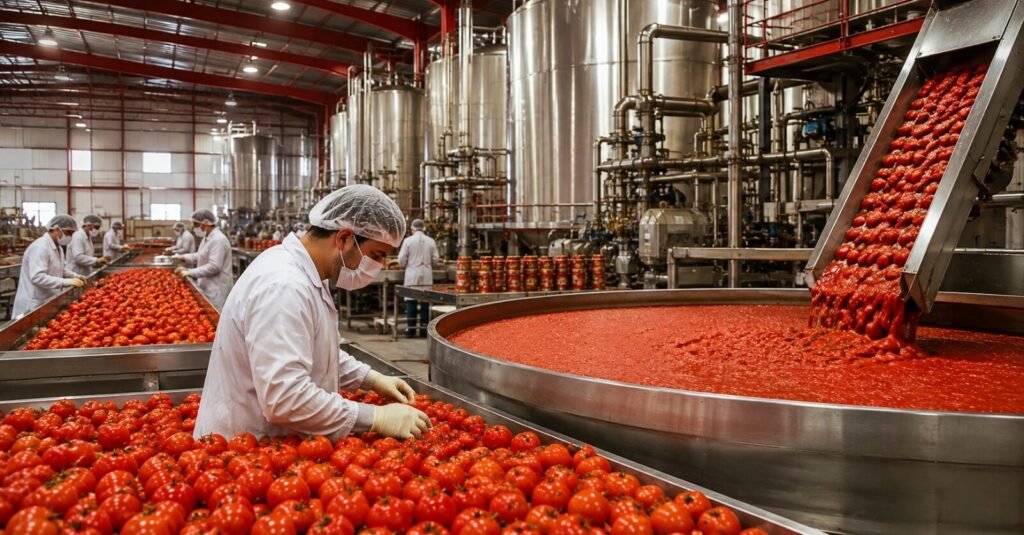
Turkey vs China tomato paste is one of the sharpest price comparisons in food commodity sourcing right now — and one of the easiest to get wrong.
A buyer based in Dubai reached out to us looking for bulk tomato paste. He needed both single concentrate (28-30% Brix) and double concentrate (36-38% Brix). The volumes were significant. The timeline was tight.
We sourced offers from Turkey and China. China came in roughly 30% cheaper.
On the surface, the decision looked straightforward. In practice, it was anything but.
This post is not just about tomato paste. It is about the sourcing decision that every procurement buyer faces when a cheaper alternative appears: how do you properly weigh price against quality, certification, supply chain risk, and long-term reliability? And what does the global tomato paste market actually look like right now?
1. The Global Tomato Paste Market in 2024-2025: What Happened
To understand the price gap we encountered, you need to understand what happened in the global tomato paste market in 2023 and 2024.
China produces tomatoes on an enormous scale — primarily in Xinjiang province, which accounts for the vast majority of Chinese processing tomato output. In 2024, Chinese production reached record levels, creating a significant global oversupply. The effect on prices was dramatic. According to industry data, China continued to offer bulk FOB prices around $900 per tonne, driving global prices down sharply.
As a result, Chinese tomato paste flooded export markets — particularly in Asia, the Middle East, and Africa — at prices that Turkish, Italian, and Spanish producers simply could not match. Turkey’s tomato paste exports actually declined by approximately 66,000 tonnes in 2024/2025 as a direct result of Chinese competition.
However, the story does not end there. In 2025, China’s tomato paste sector contracted sharply — output dropped by approximately 42% year-on-year. This reduction followed the excessive production levels of 2024, which had pushed farm-gate prices so low that many growers stopped planting. The global market is now entering a rebalancing phase. Prices are expected to rise, and supply predictability is improving.
For a buyer evaluating this market in 2024, Chinese tomato paste was genuinely cheap. The question was whether cheap was enough.
Market context for 2026
Global tomato paste prices are forecast to remain at elevated levels in 2026, with high volatility and a bias toward rising prices due to depleted inventories and constrained new production. Buyers who locked into long-term contracts with Turkish suppliers during the 2024 oversupply period are now in a stronger position than those who chased the cheapest spot price.
2. The Price Gap: Real, But Not the Whole Story
When we gathered offers for our Dubai-based client, the price differential between Turkish and Chinese tomato paste was approximately 30% in China’s favour. At significant volumes, that is a substantial sum. No serious procurement buyer ignores a 30% cost difference.
Nevertheless, price is one variable in a sourcing decision — not the only one. The total cost of sourcing includes factors that do not appear on the initial quote. Understanding those factors is what separates a good sourcing decision from a cheap one.
| Factor | Turkey | China |
|---|---|---|
| Price (bulk, FOB) | Higher — around a 30% premium in 2024 | Lower — aggressive inventory clearance pricing |
| Single concentrate (28-30%) | Available | Available |
| Double concentrate (36-38%) | Available | Available |
| Halal certification | Widely available, recognised | Available — verification required |
| EU compliance | Strong — established framework | Variable — requires due diligence |
| Colour and Brix consistency | High — well regulated | Variable — supplier dependent |
| Additive transparency | High | Less transparent — warrants testing |
| Supply chain stability | Reliable | Subject to policy and quota changes |
| Logistics to Middle East | Competitive by sea | Competitive by sea |
| Geopolitical risk | Regional — manageable | Tariff and trade policy exposure |
3. The Quality Question: Where the Real Risk Sits
For a food commodity like tomato paste, quality is not just about taste. It is about consistency, safety, and compliance — factors that become critically important when the product is used as an ingredient in manufactured food or sold into regulated markets.
Brix Level and Colour Consistency
Tomato paste is sold by concentrate level — the BRIX level in tomato paste determines the soluble solid content of the product. Single concentrate (28-30% Brix) and double concentrate (36-38% Brix) have different applications and price points. A buyer ordering double concentrate needs to receive double concentrate — consistently, across every batch.
Turkish tomato paste producers operate under well-established quality frameworks. Brix consistency across batches is a standard expectation. With Chinese suppliers, particularly smaller processors clearing inventory at aggressive prices, Brix levels and colour consistency can vary more significantly between batches. This matters most for food manufacturers using tomato paste as a consistent ingredient — a colour or concentration shift between batches affects the final product.
Additives: The Hidden Variable
This was one of our primary concerns when evaluating Chinese tomato paste offers for our client. Some lower-cost Chinese processors use additives — thickeners, colour enhancers, or preservatives — to achieve the visual and consistency profile of a higher-quality product at lower raw material cost.
This is not universal — there are high-quality Chinese tomato paste producers. However, identifying which category a given supplier falls into requires independent laboratory testing, not just a certificate of analysis provided by the supplier themselves. For a buyer in Dubai receiving a container of bulk tomato paste, discovering an additive issue after arrival is a costly and potentially market-damaging problem. Our supplier auditing guide sets out the verification sequence we apply before any first order.
Turkish producers, particularly those exporting to European markets, operate under stricter additive regulations and more transparent ingredient declaration standards. That regulatory discipline does not come for free — it is part of what the price premium reflects.
4. Halal Certification: A Non-Negotiable for Middle East Markets
Our client was based in Dubai. For any food product entering the UAE and broader GCC market, Halal certification is not optional — it is a market access requirement.
Turkish tomato paste producers exporting to the Middle East are accustomed to this requirement. Halal certification from recognised bodies is standard practice, and the documentation is well understood by Turkish exporters. The certification process is embedded in how these factories operate.
Chinese Halal certification is more complex to navigate. Certification is available — China has a growing Halal food sector. However, the certifying bodies vary in their international recognition, and verification of the specific certification’s acceptability in the UAE requires careful due diligence. Some certifications accepted domestically in China are not recognised by UAE authorities.
For our client, this was a critical filter. A 30% price saving becomes irrelevant if the product cannot clear customs or reach retail shelves.
Halal certification in the UAE
The UAE applies national Halal certification standards administered by the Ministry of Industry and Advanced Technology, which absorbed the former ESMA framework. Always verify that your supplier’s specific certifying body appears on the approved list — not just that the product carries some form of Halal certification.
5. Supply Chain Risk: What the Price Does Not Show
Beyond quality and certification, there is a broader supply chain risk dimension to the China vs Turkey decision that every procurement buyer should factor in.
Geopolitical and Trade Policy Exposure
Chinese exports are subject to trade policy dynamics that can shift faster than a supply contract. Tariff changes, export quotas, and bilateral trade tensions have disrupted Chinese food exports to various markets in recent years. A buyer who has built their supply chain entirely around Chinese tomato paste has limited options when those dynamics shift. The same exposure shows up in industrial categories — we examined it in detail in our Turkey vs China manufacturing comparison.
Turkey’s trade relationships with the Middle East are stable and long established. Turkish tomato paste has been flowing consistently to Gulf markets for decades. That market familiarity and relationship depth provides a level of supply chain resilience that spot pricing alone cannot capture.
The Geopolitical Dimension We Encountered
Our Dubai client’s project ultimately did not proceed — not because of a sourcing decision, but because of regional instability that made communication with potential end buyers impossible. This was beyond any supplier’s control.
It is, however, a reminder that food commodity sourcing — particularly in Middle Eastern markets — operates within a geopolitical context that pure price analysis ignores. Supply chain resilience means having suppliers who can respond flexibly, communicate clearly, and maintain delivery commitments when conditions become difficult. Relationship-based trade, which Turkey excels at, tends to hold up better under pressure than purely transactional supply arrangements.
6. How to Make the Right Decision for Your Brief
Every procurement decision is contextual. There is no universal answer to the Turkey vs China question for tomato paste — or for any commodity. The right answer depends on your specific market, volume, specification, and risk tolerance.
Here is the framework our team applies when evaluating competing offers for a food sourcing brief:
- Start with market access requirements. If Halal, EU, or other certification is mandatory, filter suppliers on this basis before comparing prices.
- Request independent laboratory testing. For any bulk food commodity, do not rely solely on supplier-provided certificates of analysis. Independent testing of a sample batch is a basic due diligence step.
- Calculate total landed cost. Include freight, insurance, import duties, testing costs, and any certification verification costs in your price comparison.
- Assess supply chain stability. How dependent is this supplier on a single crop season, a single region, or a single export policy regime?
- Check certifications against your specific market requirements. Not just whether a certificate exists, but whether it is recognised by the relevant authority in your destination market.
- Consider your volume and relationship strategy. For one-off spot purchases, price weight is higher. For recurring supply contracts, reliability and relationship quality become more important.
In the case of our Dubai client, Turkey was the stronger choice — not because it was cheaper, but because it cleared the Halal certification requirement cleanly, offered better quality consistency, and presented lower supply chain risk for a market where regulatory compliance is a hard gate. The 30% price premium was real. So were the reasons for it.
The Bottom Line
China’s tomato paste was cheaper in 2024. That price gap is now narrowing as Chinese output contracts and global inventories rebalance. But the broader lesson is not about a specific year’s pricing — it is about how to evaluate a sourcing decision when the cheapest option is not obviously the right one.
Price is one input. Quality consistency, certification, supply chain stability, and total landed cost are others. For food commodities entering regulated markets — particularly the Middle East — the certification and compliance dimension often determines the decision before price even becomes relevant.
Our team evaluates these factors for international buyers sourcing food products from Turkey. If you are navigating a similar decision — Turkey versus another origin, or simply trying to qualify Turkish suppliers for a food commodity brief — we would be glad to help.
Sourcing food commodities from Turkey?
MOPCONS works with international buyers sourcing agricultural and food products from Turkey — including tomato paste, hazelnut, dried fruits, olive oil, and processed foods. As your sourcing agent in Turkey, we identify qualified suppliers, verify certifications, and manage the sourcing process on the ground. Get in touch to discuss your brief.
The same sourcing intelligence applies to olive oil. Read our full analysis.
The same sourcing discipline applies to hazelnuts. Read our full market guide.
The same sourcing intelligence applies to high-value natural ingredients like rose oil.
Frequently Asked Questions
Is Turkish tomato paste Halal certified?
Yes — Turkish tomato paste manufacturers exporting to the Middle East typically hold Halal certification from internationally recognised bodies. However, always verify that the specific certifying body is recognised by your destination market’s relevant authority. For UAE imports, check against the approved list published by the Ministry of Industry and Advanced Technology.
What is the difference between single and double concentrate tomato paste?
Single concentrate tomato paste typically has a Brix level of 28-30%, while double concentrate reaches 36-38% Brix. Double concentrate has a higher solid content, more intense flavour, and lower water content — making it more economical for food manufacturers using tomato paste as an ingredient. The two specifications serve different applications and carry different price points.
How do I verify the quality of Chinese tomato paste before importing?
Independent laboratory testing of a sample batch is the most reliable method. Request samples before placing a bulk order and have them tested by an accredited third-party laboratory for Brix level, colour (using the ASTA scale), additive content, and microbiological safety. Do not rely solely on certificates of analysis provided by the supplier.
Is it better to source tomato paste from Turkey or China in 2026?
The answer depends on your market, volume, and requirements. For buyers supplying Middle Eastern markets with Halal requirements, Turkey’s certification clarity and established trade relationships give it a strong advantage. For pure commodity buyers focused on the lowest FOB price with strong in-house quality testing capability, Chinese offers may still be competitive. In 2026, however, Turkish prices are becoming more competitive as Chinese output contracts and global inventories tighten.
Need help with sourcing or trade in Turkey?
Talk to a MOPCONS consultant — we handle export, import, sourcing, representation and contracts end to end.