
Private Label Hair Care in Turkey: Why Global Brands Are Choosing It
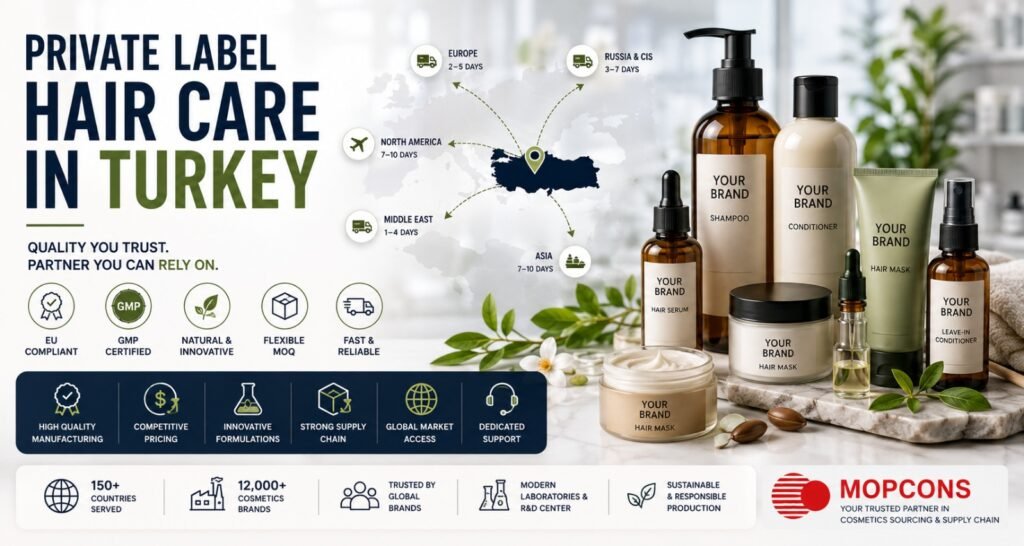
Private label hair care in Turkey has moved from a niche option to a mainstream sourcing decision — and the export numbers show exactly why.
Turkey exported $2.33 billion worth of cosmetics and personal care products in 2025. Hair care products consistently rank as the highest-value export category within that figure. Yet many international brands still overlook Turkey when they think about private label manufacturing.
That is starting to change. Over the past few years, a growing number of European, North American, and e-commerce brands have moved part or all of their private label hair care production to Turkey. The reasons are consistent: quality that meets EU standards, formulation flexibility, competitive pricing, and shorter lead times compared to Asia.
In this post, we cover why Turkey has become one of the strongest private label hair care manufacturing hubs in the world — and what brands need to know before they start sourcing.
1. Turkey’s Hair Care Industry: The Numbers Behind the Reputation
Turkey’s cosmetics sector has grown dramatically over the past two decades. In 2000, total cosmetics exports stood at just $61 million. By 2022, that figure had risen to $1.34 billion — and by 2025, total cosmetics and personal care exports reached $2.33 billion. That trajectory reflects a manufacturing sector that has modernised fast and consistently.
Hair care is the strongest single category within that export base. Turkey produces shampoos, conditioners, hair masks, leave-in treatments, scalp serums, and styling products for markets across Europe, the Middle East, and North America. The country currently hosts more than 12,000 registered cosmetics brands and a dense network of manufacturing facilities capable of handling everything from small-batch private label runs to large-scale OEM production.
For foreign brands evaluating their options, these numbers matter. Turkey is not an emerging cosmetics market. It is an established, high-volume exporter with a proven track record across multiple product categories.
2. EU Compliance Built Into the Process
For brands selling into European markets, regulatory compliance is non-negotiable. This is one of the strongest arguments for Turkey over competing sourcing destinations.
Turkish cosmetics manufacturers operate under a regulatory framework closely aligned with the EU Cosmetics Regulation. Many facilities hold GMP certification under ISO 22716 — the international standard for Good Manufacturing Practice in cosmetics production. This is not a marketing claim. It is a verifiable, third-party-audited standard that European brands are accustomed to demanding.
In practice, this means that a Turkish manufacturer producing your shampoo or hair mask is already working within the compliance framework your end market requires. That dramatically simplifies the regulatory journey compared to sourcing from countries where EU alignment requires significant additional effort.
Furthermore, many Turkish manufacturers also hold certification against the COSMOS organic standard for natural and organic product lines — a growing requirement for clean beauty brands targeting European consumers.
Why this matters for your brand
EU-compliant manufacturing means your product documentation, safety assessments, and ingredient declarations are already structured for European market entry. That reduces your regulatory burden significantly — and reduces the risk of a costly compliance failure after production.
3. Formulation Capability: Beyond Basic Shampoos
One of the most common misconceptions about Turkish cosmetics manufacturing is that it is primarily suited to commodity products — basic shampoos and generic conditioners. That was perhaps true a decade ago. It is not true today.
Turkish hair care manufacturers now offer sophisticated formulation capabilities across a wide range of product types and positioning levels. This includes:
- Sulphate-free and silicone-free formulations for clean beauty lines
- Keratin and protein-enriched treatments for professional hair care brands
- Scalp care serums and targeted treatments
- Natural and organic formulations using Turkish botanical ingredients — olive oil, rose extract, fig, pomegranate
- Hair oils, treatment ampoules, and leave-in conditioners in both retail and salon formats
- Colour-safe and colour-enhancing hair care lines
- Anti-hairloss formulations with dermatologically tested actives
Many manufacturers maintain dedicated R&D laboratories and stability testing facilities. This means they can develop a formulation from brief, test it for stability and efficacy, and take it through to production — all within the same facility.
For brands that arrive with an existing formula, Turkish manufacturers offer contract manufacturing against your specification. For brands that are still developing their product line, many offer co-development services and ready-to-customise base formulations that significantly reduce development time.
4. The Cost Advantage — and What It Actually Means
Turkey sits at a competitive price point that is difficult to match from a European manufacturing base, without the quality trade-offs that can come with sourcing from lower-cost Asian markets.
The cost advantage in Turkey comes from several factors working together:
- Lower labour costs than Western Europe, without the quality gap that often accompanies lower-cost production
- A strong domestic supply chain for raw materials, packaging components, and botanical extracts
- The Turkish Lira’s position against the euro and dollar, which can make USD or EUR-denominated contracts particularly competitive
- Shorter logistics chains to European markets — reducing freight costs, transit time, and the working capital tied up in inventory
That last point deserves emphasis. For European brands, the total landed cost of a Turkish-manufactured product is often more competitive than a comparable Asian product, even when the ex-factory price difference favours Asia. Shorter shipping times, lower freight costs, and reduced minimum order quantities all contribute to a better commercial equation.
For e-commerce and Amazon brands in particular, lead time flexibility is critical. Turkey’s proximity to European fulfilment centres allows for faster replenishment cycles and lower safety stock requirements — a meaningful operational advantage.
5. Natural Ingredients: Turkey’s Unique Raw Material Advantage
Turkey is one of the world’s most biodiverse countries in terms of plant species and agricultural production. That biodiversity translates directly into a raw material advantage for natural and organic hair care formulation.
Turkish manufacturers have access to domestically grown and processed botanical ingredients that brands sourcing from other markets must import. These include:
- Olive oil — Turkey is one of the world’s largest producers, with cold-pressed oils used widely in hair care formulation
- Rose extract — the Isparta region produces a significant share of the world’s rose oil
- Argan-compatible formulation expertise — building on the regional tradition of plant-based hair treatment
- Fig, pomegranate, and black seed — increasingly popular in clean beauty positioning
- Laurel oil — a traditional ingredient in hair and scalp care with strong consumer recognition
For brands building a natural or heritage positioning, these ingredients carry genuine story value. They connect a product to a place with real agricultural depth — which is a meaningful differentiator in a crowded clean beauty market.
6. Packaging: End-to-End Production Under One Roof
Private label hair care is not just about the formula. The packaging — bottle design, label printing, outer carton, and retail-ready presentation — is equally important for brand differentiation.
Turkey has a well-developed cosmetics packaging industry that works closely with manufacturers. Many Turkish cosmetics facilities offer turnkey production: formulation, filling, labelling, and packaging all handled within the same supply chain, often within the same industrial zone.
This integration reduces the coordination complexity that comes with managing separate formulation, packaging, and logistics suppliers across multiple countries. It also shortens the overall production timeline, since components do not need to travel between facilities.
Packaging options available through Turkish manufacturers range from standard stock formats to fully custom designs. Many facilities offer sustainable packaging alternatives — recycled plastics, biodegradable materials, refillable formats — which are increasingly required by European retail buyers.
7. What to Look for When Choosing a Turkish Hair Care Manufacturer
Not all manufacturers are equal — and the density of the Turkish cosmetics sector means there is a wide range of capability levels to navigate. When evaluating potential partners, we focus on the following:
- GMP certification (ISO 22716) — the baseline quality standard for serious cosmetics production
- In-house R&D and stability testing capability — essential if you need formulation development, not just contract filling
- Export experience and references — manufacturers with a track record of exporting to EU or North American markets understand the documentation and compliance requirements
- Minimum order quantities — these vary significantly and should match your volume profile, particularly if you are launching or testing a new line
- Private label track record — some facilities primarily serve domestic brands; look for manufacturers with demonstrated experience in white-label and private label production for international clients
- Communication quality — does the export team respond clearly, in English, with specific answers to technical questions?
A factory visit remains the most reliable way to assess a manufacturer beyond the capability deck. In our experience, the quality of QC documentation visible on the production floor tells you more than any certification list. Our supplier auditing guide covers this in detail.
The Bottom Line
Turkey has built a cosmetics manufacturing sector that genuinely competes at the top end of the global private label market. For hair care specifically, the combination of EU-aligned compliance, sophisticated formulation capability, natural ingredient access, packaging integration, and competitive pricing makes it one of the most compelling sourcing destinations available to international brands today.
That said, navigating the Turkish cosmetics manufacturing landscape requires real local knowledge. The right manufacturer for your brief — in terms of capability, MOQ, compliance level, and commercial fit — is not always the most visible one. It takes on-the-ground research, direct factory relationships, and the ability to ask the right questions in the right language.
That is exactly what our team does for international brands sourcing from Turkey. Whether you need a sourcing agent in Turkey to shortlist and audit manufacturers, or a commercial representative to manage the relationship once production starts, we cover the full cycle. If you are evaluating private label hair care production, or if a previous sourcing attempt did not deliver the results you needed, we would be glad to talk through your brief.
Sourcing private label hair care from Turkey?
Mopcons works with international brands to identify, assess, and manage private label cosmetics manufacturers in Turkey. We bring on-the-ground knowledge, factory relationships, and sourcing agent expertise to every brief. Get in touch to discuss your project.
Frequently Asked Questions
What is the minimum order quantity for private label hair care in Turkey?
MOQs vary significantly between manufacturers. Some facilities accept runs from 500 to 1,000 units per SKU — suitable for launch or test orders. Larger, more established manufacturers typically set MOQs at 3,000 to 5,000 units. The right MOQ depends on your volume profile and stage of growth. We always recommend clarifying this before shortlisting a manufacturer.
How long does private label hair care production take in Turkey?
For formulations based on existing base formulas, production timelines typically run 6 to 10 weeks from confirmed order, including stability testing and packaging. Custom formulation development from brief adds 4 to 8 weeks to that timeline. Shipping to European destinations adds 5 to 10 days by road or 7 to 14 days by sea freight.
Can Turkish manufacturers produce certified natural or organic hair care?
Yes. A number of Turkish cosmetics manufacturers hold COSMOS organic certification or work with COSMOS-certified raw material suppliers. If natural or organic certification is a requirement for your brand, confirm this specifically during manufacturer evaluation — and ask to see the certification documentation rather than relying on marketing claims.
Do Turkish manufacturers handle EU regulatory documentation?
Experienced Turkish exporters are familiar with EU Cosmetics Regulation requirements, including Product Information Files, safety assessments, and CPNP notifications. However, the level of documentation support varies between manufacturers. Clarify exactly what documentation the manufacturer provides as part of their private label service — and engage a local sourcing partner to verify this during factory evaluation.
Need help with sourcing or trade in Turkey?
Talk to a MOPCONS consultant — we handle export, import, sourcing, representation and contracts end to end.
Related Articles
 Sourcing & Supply Chain
How to Vet a Turkish Supplier: A Practical Checklist
Most Turkish manufacturers are genuine, but capability and reliability vary enormously — and some traders present themselves as factories. This is the…
Read article → Sourcing & Supply Chain
How to Write a Product Specification Sheet Your Turkish Supplier Can Actually Use
Most quality disputes start with a vague brief. What a good product specification sheet contains and how to keep it under control…
Read article → Sourcing & Supply Chain
A.TR, EUR.1 and Certificate of Origin: Which Document Do You Need When Importing from Turkey?
Three documents, three different purposes. What the A.TR movement certificate, EUR.1 and certificate of origin do for goods shipped from Turkey.
Read article →