
Turkey Produces 60% of the World’s Hazelnuts. Here’s Why 2025 Changed Everything for Buyers.
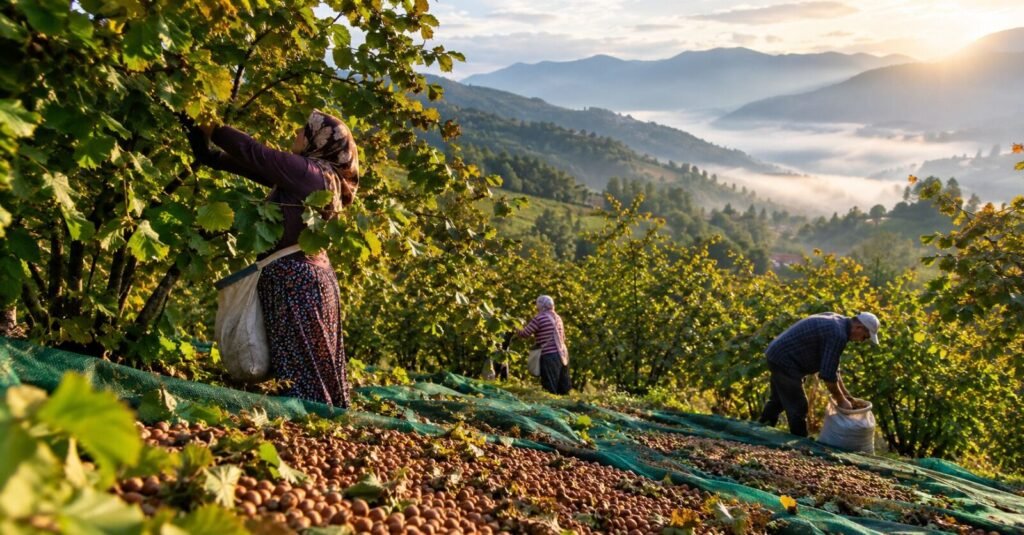
Sourcing hazelnuts from Turkey used to be the most predictable decision in food procurement. Then 2025 rewrote the rules.
Every jar of Nutella contains Turkish hazelnuts. So does every Ferrero Rocher, every Kinder Bueno, and most of the world’s hazelnut-based confectionery. Turkey does not just lead the global hazelnut market — it controls it, producing approximately 60% of the world’s entire supply from the orchards of its Black Sea coast.
For decades, that dominance made Turkey the most reliable hazelnut origin on earth. Volume was consistent. Quality was established. The supply chain, while complex, was well understood.
Then 2025 happened.
Severe April frosts devastated hazelnut orchards across Turkey’s Black Sea region. Pest infestations compounded the damage. Production — normally between 600,000 and 700,000 tonnes annually — was projected to fall to as low as 441,000 tonnes, with some regional estimates suggesting the real figure could be even lower. Prices surged. And in one of the most dramatic supply chain stories of the year, Ferrero — the world’s single largest hazelnut buyer — halted its purchases from Turkey entirely.
For any buyer sourcing hazelnuts, or considering it, this is the most important market update of the past decade. Here is what happened, what it means, and how to navigate it.
1. The Scale of Turkey’s Hazelnut Dominance
Before understanding 2025, it helps to understand just how extreme Turkey’s position in the hazelnut market actually is.
Turkey produces approximately 708,000 tonnes of hazelnuts in a normal year, according to International Nut and Dried Fruit Council statistics — around 61% of global production. The next largest producer, Italy, produces a fraction of that. Azerbaijan, Chile, and the United States follow at a significant distance.
Turkey is also the world’s largest hazelnut exporter, accounting for 63% of global export volume. Germany and Italy are the largest importers — and much of the Italian import volume, as with Turkish olive oil, goes to Italian processors who add value and re-export.
The global hazelnut market was valued at $4.2 billion in 2024 and is forecast to reach $6.4 billion by 2035. At the centre of that market, now and for the foreseeable future, sits Turkey.
How dominant is Turkey? Turkey’s hazelnut consumption alone — 706,000 tonnes — is six times larger than Italy’s, the second largest consuming country. Turkey does not just produce hazelnuts for the world. It produces hazelnuts for itself too, at a scale no other country approaches.
2. What Happened in 2025: Frost, Pests, and a Price Crisis
In April 2025, an unusual late frost swept across Turkey’s Black Sea hazelnut-growing regions — the provinces of Ordu, Giresun, Trabzon, and Rize, which together produce the majority of Turkey’s crop. The timing was devastating. The frost hit precisely when hazelnut flowers were most vulnerable, destroying a significant portion of the season’s potential yield before it could develop.
Compounding the frost damage, the brown marmorated stink bug — an invasive pest that has spread rapidly across Turkey’s hazelnut provinces in recent years — further reduced yields in affected areas. By mid-2025, Turkey’s Agriculture Ministry estimated production at around 450,000 tonnes. Independent industry estimates placed the real figure potentially as low as 300,000 to 441,000 tonnes — a reduction of 35-55% from a normal year.
The market response was sharp. Turkish hazelnut prices surged as domestic processors and international buyers competed for a significantly reduced supply. As the USDA hazelnut market report documents, import and export prices for shelled hazelnuts had already risen sharply in 2024. They continued upward into 2025, reaching over $8,300 per tonne at peak.
3. The Ferrero Crisis: When the World’s Biggest Buyer Said No
In late 2025, the global hazelnut market witnessed something unprecedented. Ferrero — the maker of Nutella, Ferrero Rocher, and Kinder Bueno, and by far the world’s single largest hazelnut buyer — temporarily halted its hazelnut purchases from Turkey.
The stated reason was price. Turkish exporters, facing a dramatically reduced crop, were holding firm on pricing that Ferrero considered above market. Ferrero’s General Manager of Hazelnut Supply stated publicly that the company was “in no hurry to buy” — a negotiating position backed by the company’s diversified sourcing model, which includes suppliers in Chile and the United States.
Turkey’s response was swift. The Competition Authority warned Ferrero of potential legal consequences, describing the purchasing halt as unacceptable market pressure on Turkish farmers who had already suffered significant yield losses. The head of the authority said publicly: “Despite yield losses, farmers have continued production with great dedication. International pressure tactics are unacceptable.”
The standoff made international headlines. Italian newspapers reported on the potential impact on Nutella supplies. Turkish farmers described the situation as an injustice. Industry analysts broadly expected an eventual compromise — but the episode revealed something important about the structural dynamics of the Turkish hazelnut market that every buyer should understand.
What the Ferrero standoff revealed. Even the world’s most powerful hazelnut buyer — with over 3,000 people working in its hazelnut supply chain, a public Ferrero hazelnut sustainability programme, and ownership of a major Turkish processor — could not simply dictate terms to Turkish producers during a supply shock. The relationship between Turkey’s hazelnut market and its international buyers is more balanced, and more politically charged, than most buyers realise.
4. The Chile Factor: A New Supply Chain Risk
One of the most significant longer-term developments in the global hazelnut market is the rise of Chile as a competitor to Turkey.
Ferrero has invested heavily in expanding hazelnut production in Chile and the United States over the past two years — precisely to reduce its dependence on Turkey. Chile’s hazelnut sector is growing aggressively, and industry insiders note that the country aims to reach 200,000 tonnes of annual production within five to ten years.
For Turkey, this represents a genuine competitive threat for the first time in decades. For buyers, it represents an emerging alternative source — though one that is still years away from matching Turkey’s scale, quality consistency, and processing infrastructure.
The practical implication for sourcing decisions today: Chile is worth monitoring but is not yet a viable primary source for most buyers. Turkey remains the market. However, the market is changing, and supply chain diversification is no longer just a good idea. After 2025, it is a necessity.
5. What This Means for Buyers Sourcing Hazelnuts from Turkey
The events of 2025 have reshaped the hazelnut sourcing landscape in ways that will last several years. Here is the practical framework for buyers evaluating their options.
Price volatility is the new normal
Turkish hazelnut prices have always been subject to seasonal variation — the crop is harvested once a year, and weather events can shift supply dramatically. What 2025 confirmed is that this volatility can be extreme: a single weather event can remove 35-50% of global supply within a season.
Buyers who rely on spot purchasing — buying when they need stock, at prevailing market prices — are the most exposed. Forward contracts and longer-term supply agreements with trusted Turkish processors provide significantly more price stability, though they require committing to volumes before the season’s production outcome is known. Either way, the total cost of sourcing — not the headline price per tonne — is the number that matters.
Processor relationships matter more than ever
The hazelnut supply chain in Turkey runs from thousands of small family farms, through a layer of local traders, to a relatively small number of large processors and exporters. The quality, reliability, and pricing you access as a buyer depends enormously on which layer of that chain you reach — and who you know within it.
Working directly with an established Turkish processor — one with its own orchards or strong farmer relationships, proper processing and storage facilities, and a verified export track record — gives buyers a fundamentally different risk profile than buying through an international broker who is themselves buying from a Turkish exporter.
A local sourcing agent in Turkey with genuine relationships in the Black Sea hazelnut-producing regions can make that access possible — and can conduct the kind of on-the-ground supplier assessment that determines which processors are genuinely reliable.
Quality consistency requires active management
The 2024-2025 Turkish crop was described by industry insiders as “large in volume but inconsistent in quality” — a recurring challenge in high-yield years, when farmers are incentivised to harvest quickly and processors face pressure to move volume. In low-yield years like 2025, quality consistency can also suffer as processors blend material from different sources to meet supply commitments.
Independent quality verification — laboratory testing for aflatoxin, moisture content, and defect rates — is therefore not optional for serious hazelnut buyers. It should be embedded in every purchase agreement as a pre-shipment requirement.
| Factor | Normal year | 2025 supply shock |
|---|---|---|
| Turkish production | 600,000–700,000 tonnes | 300,000–441,000 tonnes (est.) |
| Global supply share | ~60% | ~50–55% (reduced) |
| Price level | Moderate, seasonal variation | Sharp increase — $8,300+/tonne |
| Buyer leverage | Moderate | Reduced — sellers’ market |
| Quality consistency | Generally strong | More variable — monitor closely |
| Alternative sources | Limited | Chile and USA growing, not yet at scale |
6. How to Source Hazelnuts from Turkey: A Practical Guide
Despite 2025’s disruption, Turkey remains the essential hazelnut origin. No alternative market can replace its scale, variety, or processing infrastructure within the next five to ten years. So the question for buyers is not whether to source from Turkey — it is how to do it well.
- Define your specification clearly before approaching suppliers — shell-on vs. shelled, blanched vs. natural, roasted vs. raw, minimum kernel size, maximum defect tolerance, and aflatoxin limits.
- Target established processors in the key producing provinces — Ordu, Giresun, and Trabzon — rather than trading companies or international brokers who add margin without adding value.
- Request third-party laboratory testing of every shipment. Aflatoxin is a particular risk in Turkish hazelnuts and a market access issue for EU imports.
- Structure contracts with clear quality specifications, pre-shipment inspection rights, and price adjustment mechanisms tied to verified kernel size and quality grades.
- Consider seasonal timing. Turkish hazelnuts are harvested in August and September. Prices typically peak in the months following harvest and ease as the season progresses. Buying in Q4 or Q1 often provides better value than Q3.
- Build relationships across the supply chain. Knowing both a processor and a cooperative in the same region gives you market intelligence and negotiating context that single-source buyers lack.
The verification steps are the same ones we set out in our supplier auditing guide: documents first, then the facility, then the sample, then the trial order. Hazelnuts simply raise the stakes on the sample-testing step.
The Bottom Line
Turkey’s hazelnut dominance is structural and durable. No other country comes close to matching its production scale, and the Black Sea region’s climate and agricultural tradition give it advantages that cannot be replicated quickly elsewhere. Chile’s growth is real but gradual.
What 2025 confirmed is that even a dominant market can be disrupted — by weather, by pests, and by the negotiating dynamics between the world’s largest buyer and its most important supplier. The buyers who navigated 2025 best were those with forward contracts already in place, direct relationships with established processors, and the supply chain flexibility to manage a shorter-than-expected season.
If you are sourcing hazelnuts from Turkey — or evaluating Turkey as an origin for the first time — the lesson is clear. The market rewards preparation, relationships, and on-the-ground knowledge. It punishes late decisions, broker dependency, and reactive purchasing.
Sourcing hazelnuts or other food commodities from Turkey? MOPCONS works with international buyers sourcing agricultural and food products directly from Turkish producers and processors. We identify qualified suppliers, verify credentials and quality processes, and manage the sourcing relationship on the ground. Get in touch to discuss your sourcing brief.
Frequently Asked Questions
Why are Turkish hazelnut prices so high in 2025?
Turkey’s 2025 hazelnut crop was severely damaged by late April frosts and pest infestations across the Black Sea growing regions. Production is estimated to have fallen by 35-55% from normal levels, creating a supply shock that pushed prices sharply higher. Import and export prices for shelled hazelnuts reached over $8,300 per tonne at peak — significantly above recent averages.
Is Chile a viable alternative to Turkey for hazelnut sourcing?
Not yet at scale. Chile’s hazelnut sector is growing rapidly, supported by investment from major buyers including Ferrero, and is targeting 200,000 tonnes of annual production within five to ten years. However, Turkey’s output of 600,000-700,000 tonnes in a normal year means Chile cannot serve as a primary replacement for most buyers in the near term. Chile is worth incorporating into a diversified sourcing strategy, but not as a primary source.
What is aflatoxin and why does it matter for Turkish hazelnut buyers?
Aflatoxin is a naturally occurring mycotoxin produced by certain moulds that can contaminate hazelnuts during harvesting, drying, or storage in warm, humid conditions. The EU sets strict maximum limits for aflatoxin in hazelnuts intended for human consumption. Turkish hazelnuts have historically faced scrutiny at EU border inspections for aflatoxin levels, making independent pre-shipment testing a non-negotiable quality control step for any buyer supplying European markets.
Should I buy hazelnuts on the spot market or use forward contracts?
For buyers with predictable annual volumes, forward contracts with established Turkish processors provide significantly better price stability than spot purchasing. The hazelnut market is highly seasonal and weather-sensitive — spot prices can move dramatically between seasons, as 2025 demonstrated. Forward contracts require committing to volumes before the harvest outcome is known, but they protect against the kind of supply shock that caught many buyers unprepared in 2025.
Need help with sourcing or trade in Turkey?
Talk to a MOPCONS consultant — we handle export, import, sourcing, representation and contracts end to end.
Related Articles
 Sourcing & Supply Chain
Supplier Side. Client Side. What Both Projects Taught Us About Representation.
We represented the supplier on a €4 million automated warehouse project and we represent the client on a €6 million industrial installation.…
Read article → Sourcing & Supply Chain
Your “Italian” Olive Oil Might Be Turkish. Here’s What Every Buyer Should Know.
Turkey is the world's second largest olive oil producer — and for decades much of it left the country in bulk, to…
Read article → Sourcing & Supply Chain
Turkey vs China Tomato Paste: Why the Cheapest Option Isn’t Always the Right One
China's tomato paste came in 30% cheaper for a Dubai buyer. Here is how we weighed price against Brix consistency, additives, Halal…
Read article →